

Davos | January 20, 2026
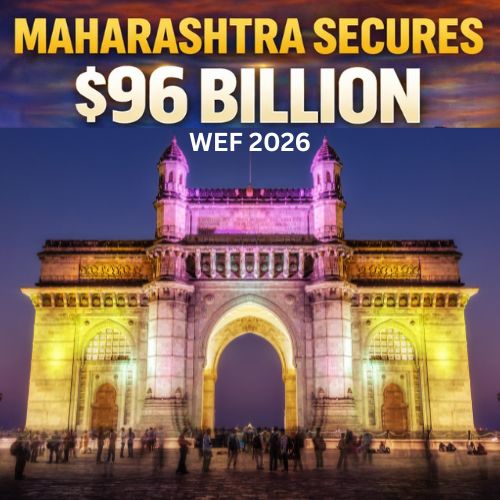
Maharashtra has delivered one of India’s most significant global investment wins at the World Economic Forum (WEF) 2026 in Davos, with the Mumbai Metropolitan Region Development Authority (MMRDA) securing USD 96 billion (₹8.73 lakh crore) in investment commitments on the very first day of the summit.
Table of Contents
The landmark achievement came through the signing of 10 high-impact Memoranda of Understanding (MoUs) spanning infrastructure, logistics, fintech, artificial intelligence, sports innovation, sustainability, and advanced urban technologies. Together, these projects are expected to generate approximately 9.6 lakh direct and indirect jobs, positioning the Mumbai Metropolitan Region (MMR) as one of Asia’s most powerful innovation and startup-driven economic hubs.
This development firmly places Maharashtra at the centre of India’s next growth cycle and reinforces Mumbai’s transformation under the Mumbai 3.0 vision.
Maharashtra’s Davos Moment: From Vision to Execution
The MoUs were signed in the presence of Maharashtra Chief Minister Devendra Fadnavis, with Sanjay Mukherjee, IAS, Metropolitan Commissioner, MMRDA, representing the authority at Davos.
Calling the achievement historic, CM Fadnavis stated that the USD 96 billion investment commitment reflects unwavering global investor confidence in Maharashtra’s long-term economic potential. He described the MoUs as the blueprint for Mumbai 3.0, aligning infrastructure expansion with technology, sustainability, and large-scale employment generation.
According to the Chief Minister, Maharashtra’s strategy is no longer about pitching future potential. Instead, the state is executing at scale with a clear roadmap toward becoming a USD 1 trillion economy, with Mumbai and the MMR acting as the primary growth engines.
Deputy Chief Minister and MMRDA Chairman Eknath Shinde echoed this sentiment, stating that these projects will transform Mumbai, Thane, Kalyan, and surrounding regions into a globally competitive, technology-driven urban ecosystem.
What Is Mumbai 3.0?
Mumbai 3.0 represents the next phase of the region’s evolution — moving beyond traditional finance and real estate into a multi-sector innovation ecosystem powered by:
- AI-driven urban governance
- Digital twins for city planning
- Fintech and enterprise innovation districts
- Sustainable, net-zero industrial corridors
- Sports science, health tech, and skill-tech hubs
This vision aligns closely with global urban innovation models seen in cities such as Singapore, London, and Seoul, but at a scale uniquely suited to India.
Key MMRDA MoUs Signed at WEF 2026
The MMRDA MoUs at Davos 2026 represent a mix of capital-intensive infrastructure projects and future-facing innovation platforms.
SBG Group – USD 45 Billion
SBG Group signed the largest MoU with MMRDA, committing USD 45 billion to develop integrated logistics, industrial, and digital infrastructure hubs across the Mumbai Metropolitan Region.
- Focus areas: logistics parks, digital infrastructure, smart industrial zones
- Estimated job creation: 4.5 lakh jobs over 10 years
This investment is expected to significantly boost demand for logistics-tech startups, supply-chain SaaS platforms, warehouse automation, and AI-driven operations tools.
Panchshil Realty – USD 25 Billion
Panchshil Realty committed USD 25 billion to develop:
- Fintech districts
- Integrated urban townships
- Industrial-logistics hubs
- Estimated job creation: 2.5 lakh jobs
The fintech-focused districts are likely to attract financial services startups, payment platforms, wealth-tech companies, and enterprise SaaS firms, reinforcing Mumbai’s position as India’s fintech capital.
K Raheja Corp – USD 10 Billion
K Raheja Corp signed an MoU worth USD 10 billion to develop three Innovation Cities across the MMR.
These Innovation Cities will focus on:
- Artificial Intelligence
- Fintech
- Gaming and immersive technologies
- Logistics innovation
- Sports technology
- Estimated job creation: 1 lakh jobs
This initiative directly supports the growth of deep-tech startups, gaming studios, AI labs, and B2B technology firms.
IISM Global – USD 8 Billion
IISM Global committed USD 8 billion to establish a global-standard Integrated Sports City and a Sports Innovation & Skill-Tech University.
- Focus areas: sports science, sports medicine, athlete development, education technology
- Estimated job creation: 80,000 jobs
This investment opens new opportunities for sports tech startups, health tech innovators, wearables companies, and performance analytics platforms.
Sumitomo Realty & Development – USD 8 Billion
Japan-based Sumitomo Realty & Development committed USD 8 billion to develop a world-class High Street District and transit-oriented development at Bandra Kurla Complex (BKC).
- Estimated job creation: 80,000 jobs
The project strengthens Mumbai’s appeal as a global business destination and enhances demand for urban mobility startups, proptech platforms, and smart infrastructure solutions.
Global Knowledge & Technology Partnerships
Beyond financial investments, MMRDA signed several strategic knowledge and technology MoUs with leading global institutions, strengthening Mumbai’s long-term innovation capacity.
University of California, Berkeley
Collaboration areas include:
- Artificial intelligence
- Sustainability
- Urban policy
- Innovation ecosystems
This partnership supports advanced research and startup-academic collaboration.
Japan International Cooperation Agency (JICA)
JICA will act as a strategic partner for:
- Unified digital architecture for multimodal mobility
- Transport digital twins
- Smart transit systems
This will play a critical role in deploying AI-driven mobility platforms and real-time urban analytics.
Sembcorp Development Ltd (Singapore)
Sembcorp will support the development of low-carbon, net-zero industrial ecosystems across strategic corridors in:
- Palghar
- Raigad
- Kharbav
This creates opportunities for climate tech startups, clean energy providers, and sustainability-focused manufacturing solutions.
Technical University of Munich (TUM), Germany
TUM will collaborate on:
- Advanced mobility engineering
- Climate-resilient urban planning
- Transit-oriented development
Urban Futures Collective (London), MIT Media Lab & UCL
Together, these institutions will help develop open-source digital twin platforms for evidence-based metropolitan governance.
Digital twins are expected to become the backbone of future urban tech startups, enabling simulation-driven planning and policy design.
Why Maharashtra’s WEF 2026 Investments Matter for Startups
The Maharashtra WEF 2026 investments go far beyond infrastructure spending. They create long-term demand ecosystems where startups can scale alongside large enterprises and public institutions.
Key startup sectors set to benefit include:
- Urban tech & digital twins
- AI, fintech, and govtech platforms
- Logistics, supply-chain SaaS, and automation
- Sports tech, health tech, and skill-tech
- Climate tech and net-zero manufacturing
For founders and investors, Mumbai is no longer just a financial capital. It is emerging as a globally competitive innovation megaregion.
Maharashtra’s Growing Global Startup Reputation
This Davos success builds on Maharashtra’s consistent performance as one of India’s strongest startup ecosystems. With policy support, capital inflows, and world-class partnerships aligning, the state is positioning itself alongside global innovation hubs.
With USD 96 billion in MoUs secured at WEF 2026, Maharashtra has moved decisively from ambition to execution. The Mumbai 3.0 startup ecosystem is no longer a future vision — it is actively taking shape through capital, policy, and global collaboration.
For startups, investors, and innovators, the Mumbai Metropolitan Region is fast becoming one of the most important growth platforms in Asia.
Frequently Asked Questions
How much investment did Maharashtra secure at WEF 2026?
Maharashtra secured USD 96 billion (₹8.73 lakh crore) in investment commitments at WEF 2026 through MMRDA.
When were the MoUs announced?
The MoUs were announced on the first day of the World Economic Forum (WEF) 2026.
How many jobs are expected to be created?
The MoUs are expected to generate approximately 9.6 lakh direct and indirect jobs across the Mumbai Metropolitan Region.
What is Mumbai 3.0?
Mumbai 3.0 is Maharashtra’s next-phase urban transformation strategy focused on infrastructure, AI-driven urban tech, sustainability, and innovation-led growth.
Which authority facilitated these MoUs?
The Mumbai Metropolitan Region Development Authority (MMRDA) facilitated and signed the investment MoUs.
Which startup sectors will benefit the most?
Urban tech, AI, fintech, logistics SaaS, health tech, climate tech, sports tech, and sustainable manufacturing startups are expected to benefit.
Why is this significant for startups?
The investments create long-term demand, infrastructure readiness, and policy support, enabling startups to scale faster.
Why does this matter for investors?
The scale and structure of these investments reduce market risk and create stable ecosystems for long-term venture returns.
How does Mumbai 3.0 compare globally?
Mumbai 3.0 positions the region alongside leading global innovation hubs by combining capital, infrastructure, and policy alignment.
Where can readers follow updates on the startup ecosystem?
Readers can follow BestStartup for ongoing coverage of startups, investments, and ecosystem developments.
Follow BestStartup for more startup, investment, and ecosystem insights.
Follow BestStartup