
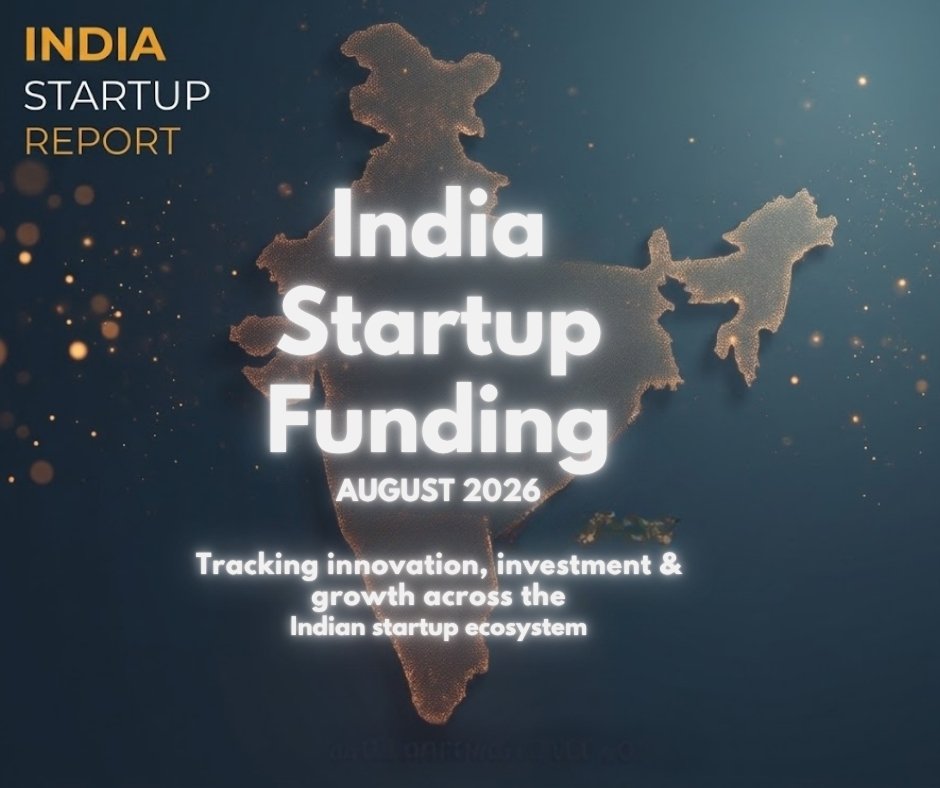
There is something the weekly data about India’s startup funding reveals that the monthly totals hide. Each week in August 2026 was dominated by a single company that pulled the entire week’s numbers upward. Remove that one company and the rest of the week looks modest. Include it and India looks like one of the hottest startup markets on earth.
The pattern is important to understand. India’s ecosystem is producing category-defining companies — but they are surrounded by a much smaller number of other large rounds than you would find in a comparable US or UK week. What the weekly leaders share is operational proof — not pitch decks or projections, but working products in commercial use with paying customers.
Follow every India startup funding story at https://beststartup.in/
WEEK 1 — AUGUST 3 TO 8: RIVER MOBILITY CHARGES FIRST
The numbers: 23 Indian startups, $252 million total, one company accounting for nearly half of everything.
River Mobility raised $120 million in a Series C from Elev8 Venture Partners and Claypond Capital. The Bengaluru-based electric two-wheeler company had sold more than 27,000 Indie electric scooters by July 2026. The $120 million will fund expanded manufacturing in Karnataka a new facility capable of producing up to 80,000 electric scooters per month and additional utility-focused EV models designed for delivery fleets and commercial operators.
The rest of the week was active across sectors. Adiabatic Technologies raised funds to expand battery manufacturing capacity to 100 MWh annually for robotics, defence, drones, and electric mobility. Government-startup partnership announcements in agritech and defence created new early-stage activity. The week also saw the first signals of what would become a significant theme in August 2026: AI companies that are not in the consumer AI space, but in the industrial and infrastructure AI space.
India raised $8.44 billion across 603 rounds so far in 2026 by the end of Week 1. River Mobility’s round was electric mobility’s largest check of the month and a signal of how seriously institutional investors are taking India’s EV infrastructure opportunity.
WEEK 2 — AUGUST 10 TO 15: YULU TAKES THE LEAD AND DEFENCE SURPRISES
The numbers: 13 Indian startups, $242 million total, Yulu accounting for nearly 38% alone.
Yulu raised $93 million in a Series C led by GEF Capital Partners. The Bengaluru-based shared electric mobility company operates electric two-wheeler fleets in urban corridors a model that is fundamentally different from River Mobility’s consumer product play. Yulu is infrastructure. Its fleets sit at metro station exits, in corporate campuses, and at residential society gates. Its revenue comes from per-minute usage by commuters who need to cover the last mile between mass transit and their destination.
The $93 million was notable for what it implied about Yulu’s unit economics. GEF Capital Partners led, which is significant. GEF is a growth equity firm focused on sustainable businesses with measurable environmental impact. Their investment thesis requires evidence that the business actually reduces carbon emissions at scale, not just that it claims to. Yulu’s urban EV fleet replacement of petrol two-wheeler trips is measurable. The investment reflects evidence, not optimism.
Sigma Advanced Systems raised $48.03 million for defence and aerospace manufacturing. The Blacksmith software testing platform raised $45 million. Centricity, a healthcare company, raised a meaningful round. Defence and aerospace were visible in India’s startup funding data for the second week running a new category for a country that has historically left defence manufacturing to public sector giants.
WEEK 3 — AUGUST 17 TO 22: THE $469 MILLION EXPLOSION
The numbers: 20 Indian startups, $469.8 million total — 94% up week-on-week.
This was India’s defining startup week of August 2026 and arguably one of the most significant weeks in the Indian startup ecosystem’s history. What made it significant was not just the volume. It was the diversity. Twenty companies across fintech, voice AI, geospatial intelligence, data infrastructure, enterprise AI, agritech, healthtech, quick-commerce, and robotics all raised capital in the same seven-day window.
Wispr Flow led with $280 million from Menlo Ventures at a $2 billion valuation. The voice AI company accounted for nearly 60 percent of the week’s total capital a level of concentration unusual even by India’s pattern of single-company-dominated weeks. The round’s significance is the valuation. $2 billion for a Series B voice AI company based in India is a milestone that the ecosystem has not seen in this category before.
Navi raised $100 million from Prosus. Sachin Bansal’s fintech company — India’s most prominent comeback story completed its first institutional round, marking a significant milestone in the company’s transition from founder-funded to institutionally-backed.
CtrlS raised $26.11 million for data centre infrastructure, backed by Nikhil Kamath and Sreeram Reddy Vanga.
NeoGeo raised $20 million in a Series A co-led by Neev Fund II and Aavishkaar Capital.
Together, the four rounds above $20 million -Wispr, Navi, CtrlS, and NeoGeo accounted for more than 90 percent of the week’s total capital. The sixteen remaining companies shared the rest. That concentration is the honest picture of India’s funding market in August 2026.
WEEK 4 — AUGUST 24 TO 28: AIRBOUND LANDS AND SPACE LAUNCHES
The numbers: Airbound $37 million, Runable $21 million, InspeCity INR 100 crore, Ringg AI $10 million Series A extension.
Airbound’s $37 million Series A, led by Greenoaks with participation from DoorDash, Lachy Groom, Lightspeed, and Humba Ventures, was the week’s most important round — not because of its size, which was modest compared to the previous three weeks, but because of what it represents.
Airbound has completed more than 13,000 autonomous drone delivery flights with zero failures. Not simulations. Live commercial flights inside Narayana Health’s hospital network in Bengaluru, carrying diagnostic samples between facilities on a route that went live in January 2026. Narayana Health cancelled its ground transport on the route within one week of Airbound going live.
The commercial agreement with Andhra Pradesh targeting 10,000 daily drone flights across a three-city network was announced simultaneously with the funding. The combination of a proven commercial track record, a government contract, and backing from DoorDash — a company that knows last-mile logistics better than almost anyone — makes this round disproportionately significant relative to its dollar size.
Runable raised $21 million in a Series A from Susquehanna Venture Capital, Nexus Venture Partners, Peak XV Partners, and TDV Partners for its platform that helps small businesses automate customer acquisition and marketing. InspeCity raised INR 100 crore in a pre-Series A for satellite servicing missions — India’s space technology sector making its presence known in Week 4.
WHAT DID INDIA’S TECH GIANTS DO IN AUGUST 2026?
Razorpay launched Vulcan — India’s first transformer-based AI foundation model built for payments — during Week 3 of August. Built with NVIDIA and AWS on 3 trillion data points from 4 billion transactions, Vulcan is Razorpay moving from payment processor to AI infrastructure company. Blinkit, redBus, and Bachatt are already live with Vulcan components.
Zomato’s Blinkit continued expanding its quick-commerce network, adding cities and dark store capacity through August. The company’s success has made quick-commerce India’s most imitated startup category in 2026.
Shiprocket’s IPO listed at a 35 percent premium on August 19 after 99.38 times oversubscription — the largest successful tech IPO listing of the Indian startup cycle in recent memory.
India’s startup ecosystem is producing world-class companies every week. From drones to voice AI to electric mobility — follow every story at Beststartup.in
KEY TAKEAWAYS
Week 1 (Aug 3-8): $252M raised. River Mobility leads with $120M Series C for EV manufacturing expansion. Week 2 (Aug 10-15): $242M raised. Yulu leads with $93M for urban EV fleet infrastructure. Week 3 (Aug 17-22): $469.8M raised — 94% week-on-week jump. Wispr Flow $280M, Navi $100M, CtrlS $26M, NeoGeo $20M. Week 4 (Aug 24-28): Airbound $37M after 13,000 zero-failure flights. Razorpay launches Vulcan AI payments model with NVIDIA. Shiprocket IPO 35% listing premium.
FAQ
What was the biggest Indian startup round in August 2026?
Wispr Flow raised $280 million from Menlo Ventures in Week 3 (August 17-22), accounting for nearly 60% of that week’s total Indian startup funding. The round valued the voice AI company at $2 billion — a milestone for the category in India.
Why did River Mobility raise $120 million?
River Mobility, a Bengaluru-based electric two-wheeler maker with 27,000+ scooters sold, raised $120 million in a Series C to expand manufacturing in Karnataka to 80,000 units per month and develop commercial fleet-focused EV models.
What is Yulu and why did it raise $93 million?
Yulu operates shared electric two-wheeler fleets at metro stations, corporate campuses, and residential complexes across Indian cities. Its $93 million Series C from GEF Capital Partners was backed by evidence of measurable carbon emission reductions — a requirement for GEF’s sustainable investment thesis.
What is Airbound’s achievement that made its funding significant?
Airbound has completed 13,000+ autonomous drone delivery flights with zero failures inside Narayana Health’s hospital network. The hospital cancelled ground transport on the route within one week of launch. The company simultaneously secured a commercial deal with Andhra Pradesh for 10,000 daily drone flights.
What did Razorpay launch in August 2026?
Razorpay launched Vulcan — India’s first transformer-based AI foundation model built specifically for payments. Trained on 3 trillion data points from 4 billion transactions with NVIDIA and AWS, Vulcan improves routing, fraud detection, and checkout personalisation for merchants including Blinkit and redBus.
What was notable about Shiprocket’s IPO in August 2026?
Shiprocket listed on August 19, 2026 at a 35% premium to its IPO price after being subscribed 99.38 times. It was one of the most significant Indian startup public market exits in recent years, signalling strong public market appetite for profitable logistics tech companies.