

Have you ever wondered what happens when a nation decides it won’t just follow technological change, but lead it?
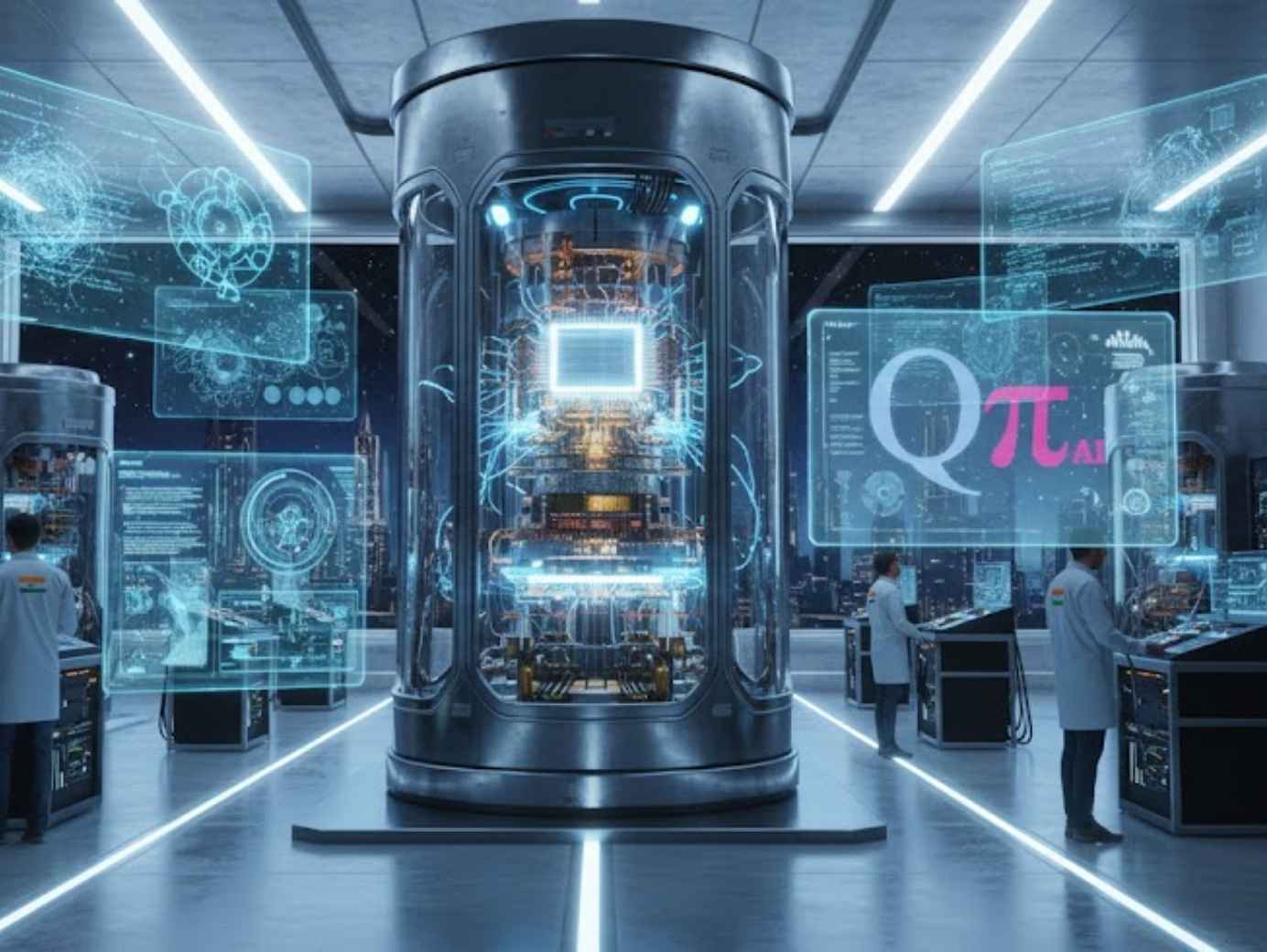
India’s quantum story just hit a historic inflection point and it’s not by accident. At the center of this shift stands QpiAI, a Bengaluru-based deep-tech startup building something most countries only dream about: a full-stack quantum ecosystem that merges advanced quantum hardware, AI-driven calibration, hybrid HPC integration, and real-world applications in one vertically integrated platform.
Table of Contents
What Is QpiAI?
QpiAI’s name itself reflects its philosophy “Q” for quantum, “pi” for precision, and “AI” for intelligence — a deliberate convergence of physics and artificial cognition.
- QpiAI is a deep-tech startup based in Bengaluru (India).
- The name breaks down as: Q = Quantum, pi = π (the mathematical constant), and AI = Artificial Intelligence.
- QpiAI’s mission: build a vertically integrated quantum + AI stack — hardware, software, AI, and application-level quantum solutions.
- Their use cases span life sciences, logistics, materials, optimization, generative AI, and more.
Its first breakthrough machine is QpiAI-Indus, a 25-qubit superconducting quantum computer named after the Indus Valley Civilization to symbolize India’s scientific heritage.
Indus is not just a chip it’s a full-stack system with quantum processors, low-temperature cryogenic architecture, control electronics, AI-optimized signal fidelity, and a high-performance computing layer that stitches quantum and classical workloads into a single operational framework.
This is India’s first end-to-end quantum computer built under the National Quantum Mission, placing the country among the few nations capable of producing full-stack quantum systems.
Following Indus on the roadmap is Kaveri, a next-generation 64-qubit superconducting quantum processor designed to deliver better coherence, lower error rates, and a scalable architecture that can support advanced applications across life sciences, materials discovery, optimization, and generative AI.
While Indus demonstrates capability, Kaveri demonstrates ambition a signal that India is aggressively preparing for the era where quantum machines will outperform classical HPC for specialized workloads.
Together, QpiAI, Indus, and Kaveri represent India’s leap from quantum curiosity to quantum leadership — a transformation accelerated by national funding, university programs, and a rapidly growing talent pipeline.
How Are Indus and Kaveri Different — and Connected?
| Term | Type | Key Features | Qubit Count | Purpose / Role |
|---|---|---|---|---|
| QpiAI | Startup / Platform | Full-stack quantum + AI ecosystem, software, hardware, applications | N/A | Builds India’s quantum technology roadmap, develops processors and full systems |
| Indus | Quantum Computer (First Gen) | Full-stack system, superconducting qubits, AI optimization, hybrid HPC integration | 25 | Operational first-generation quantum system under India’s National Quantum Mission |
| Kaveri | Next-Gen Quantum Processor | Improved coherence, error mitigation, larger-scale computation, scalable architecture | 64 | Future-generation quantum chip for more powerful applications |
QpiAI Launches Kaveri
QpiAI Kaveri is a 64-qubit superconducting quantum processor chip. It utilizes QpiAI’s proprietary superconducting flip-chip integrated technology for scalable quantum processors, featuring wafer-scale fabrication for high qubit density, flip-chip architecture with low-loss interconnects, and separation of qubit and interconnect layers for optimized performance.
What Is “Kaveri”?
- Kaveri is QpiAI’s next-generation quantum processor, planned after Indus.
- Specifically, it is reported to be a 64-qubit superconducting processor.
- According to QpiAI’s roadmap, Kaveri is expected to have better coherence times (they target ~100 µs) and built-in error-mitigation features.
- “Kaveri” will play a role in scaling quantum capability in India — it’s not just a research chip, but a step toward more powerful quantum machines.
What Is “Indus” in QpiAI-Indus?
- QpiAI-Indus is the codename for QpiAI’s first quantum computer.
- It is a 25-qubit superconducting quantum processor.
- “Indus” references the Indus Valley Civilization, symbolizing India’s scientific heritage and legacy.
- This system is described as full-stack: it combines the quantum processor (QPU), AI-driven control/optimization, and a hybrid quantum-HPC software platform.
- It integrates with a classical high-performance computing (HPC) center so it can run hybrid workloads.
- Key hardware details: superconducting (transmon) qubits, proprietary control electronics, and low-temperature cryogenic architecture
- For India, that moment arrived the day QpiAI-Indus came to life a 25-qubit, full-stack quantum computer built by Bengaluru-based QpiAI under the National Quantum Mission.
This wasn’t just another lab upgrade.
This was India declaring:
“We’re stepping into the future on our own terms.”
Quantum computing isn’t merely faster computing. It’s a complete reinvention of what computation can even achieve. And for the first time, India has placed its own machine on that global stage.
But before we talk about the machine…
Let’s start with a question.
Why Are Countries Racing Toward Quantum Computing?
Because the rules of the digital world are about to change — permanently.
Ask any technologist this simple question:
What happens the day a quantum computer breaks classical encryption?
The answer is unsettling. Everything we rely on banking, national security, satellites, health records becomes vulnerable.
If one country has quantum power and another doesn’t, the imbalance is immediate.
That’s exactly why India’s quantum leap isn’t optional it’s existential.
QpiAI-Indus: The Quantum Engine India Has Been Waiting For
The machine at the centre of this shift is QpiAI-Indus, a full-stack superconducting quantum computer built with 25 qubits. But the number alone doesn’t tell the story.
What makes QpiAI-Indus unique is its full-stack architecture:
1. Quantum Hardware
A superconducting 25-qubit quantum processor engineered with ultra-low noise, cryogenic precision, and scalable architecture.
2. Quantum-HPC Software Platform
Algorithms, compilers, and hybrid computing tools that translate real industry problems into quantum-executable tasks.
3. AI-Native Optimization Layer
Called AINN, this system uses artificial intelligence to optimise quantum circuits and reduce error rates automatically.
4. Application Layer
Tools for fields like:
- Drug discovery
- Climate modelling
- Mobility and logistics
- Materials science
- Secure communications
- Quantum-enhanced AI
This is not a prototype.
This is a fully deployable operational ecosystem, the kind that only a handful of nations can claim.
And yes , this came from an Indian startup funded through the National Quantum Mission (NQM).
Why This Matters: The National Quantum Mission Vision
To understand QpiAI-Indus, you need to understand the mission powering it.
India’s National Quantum Mission (NQM) aims to build:
- Quantum computers up to 1000 qubits
- Quantum-safe encryption
- National quantum communication networks
- Quantum materials and devices
- India’s biggest quantum talent ecosystem
Before this mission, India had scattered pockets of research.
Now, there’s a nationwide roadmap — structured, funded, and aggressively pushing toward global leadership.
QpiAI is just one success story emerging from that ecosystem… but it’s a massive one.
India’s Quantum Wave: Labs, Centers, Programs, and a Quantum Village
What makes this moment even more powerful is that QpiAI’s breakthrough is not occurring in isolation.
India is building a quantum nation, piece by piece.
Let’s look at the most significant developments.
1. Indian Army + IIT Delhi: India’s First Quantum Lab
India’s defence infrastructure has entered the quantum era through a first-of-its-kind military quantum lab built in collaboration with IIT Delhi.
Its goals include:
- Next-generation encryption
- Real-time battlefield simulations
- Quantum communication systems
- Advanced sensing and navigation
This ensures India isn’t just building quantum power — it’s securing national sovereignty for the decades ahead.
2. IBM + TCS: Building the World’s Largest Quantum Lab in Andhra Pradesh
In one of the biggest partnerships of the decade, IBM and TCS are joining forces to build the world’s largest quantum computing lab at the newly developed Quantum Valley Tech Park in Amaravati.
This centre will:
- Train India’s future quantum workforce
- Support global enterprises
- Serve as India’s primary quantum research hub
- Accelerate product-level quantum applications
Amaravati is no longer just a proposed capital — it’s becoming a global quantum corridor.
3. India’s First Quantum Computing Village – Amaravati
The Government of Andhra Pradesh has approved the development of the country’s first quantum computing village.
This dedicated ecosystem will include:
- A quantum data center
- Quantum-enabled HPC clusters
- Government-supported R&D labs
- Infrastructure created alongside TCS and L&T
- Facility for IBM’s advanced quantum systems
Once completed, this will be one of the most advanced quantum tech zones in Asia.
4. Academic Revolution: India Launches Its First Quantum Computing Degree
You asked about the courses.
Here’s the future.
Beginning academic year 2026, Andhra University is launching India’s first full-scale Quantum Computing degree, approved by the Academic Senate.
Key features:
- 30 seats via APEAPCET
- Interdisciplinary structure including ECE, CSE, Physics, Mathematics, Instrumentation
- Built in collaboration with national quantum labs
- Designed to create industry-ready quantum engineers
This is a landmark.
India is not just building quantum technology — it’s building the talent to support it.
In a world where quantum scientists are rarer than astronauts, this program will be a career-defining opportunity.
So… How Will Quantum Computing Affect Everyday Life?
This is the question ordinary people ask.
And here’s the truth — quantum computing is already connected to daily life in ways most don’t realise.
1. Drug Discovery and Medicine
Today, building a new drug takes:
- 10+ years
- Billions of dollars
- Animal trials
- Multiple human trial phases
Why?
Because classical computers can’t simulate large molecules.
Quantum computers can.
They can simulate molecular behavior at atomic accuracy, reducing drug discovery from years to weeks.
This could:
- Cure rare diseases faster
- Reduce medication costs
- Eliminate harmful side effects
- Personalize treatments
Imagine a world where your medicine is designed exactly for your body.
Quantum unlocks that reality.
2. Weather Forecasting and Climate
Quantum systems can process atmospheric data in ways classical machines simply cannot.
This means:
- More accurate cyclone prediction
- Early flood and drought warnings
- Better agriculture planning
- Climate models with 10x more detail
For a country like India, this is priceless.
3. National Security and Encryption
A powerful quantum computer can break classical encryption in minutes.
That’s why:
- India is building quantum-safe communication
- The Army has set up its quantum lab
- Post-quantum cryptography is becoming mission-critical
Quantum is not just innovation — it’s national protection.
4. AI Acceleration
Quantum computing doesn’t replace AI.
It multiplies what AI is capable of.
Faster model training.
Better optimization.
Smarter prediction systems.
AI + Quantum = A new era of cognitive computing.
India’s Place in the Global Quantum Landscape
Only a few nations have built credible quantum capabilities:
- USA
- China
- Canada
- Japan
With QpiAI-Indus, the quantum lab collaborations, and the NQM ecosystem, India becomes the fourth major quantum nation with a national mission, hardware, and academic programs to match.
This is not symbolic.
This is structural.
India is building quantum knowledge, quantum infrastructure, and quantum talent all at once.
QpiAI-Indus Is Just the Beginning — What Happens Next?
India’s quantum roadmap is bold, and the next decade will bring:
- 100 to 1000-qubit systems
- Quantum-secure national networks
- Quantum-AI enterprises
- Quantum microchip fabs
- Quantum-ready supercomputing clusters
- Entire quantum cities and corridors
Quantum is not the future.
Quantum is the foundation of the future.
And India is now shaping that foundation.
So What Should You Do Now? (Your Filler Section)
If you’re building content, platforms, or coverage around this quantum wave, here’s what you should add next:
1. Build topical authority on quantum tech
Create:
- Explainers
- Timelines
- Interviews
- India-focused analysis
- Quantum education guides
2. Track the Andhra Pradesh quantum developments
This includes:
- Quantum Valley Tech Park
- IBM–TCS partnerships
- Quantum Village project
- The first academic batch in 2026
3. Cover the real-world impact story
Write about:
- Quantum in medicine
- Quantum in AI
- Quantum in defence
- Quantum in climate modelling
4. Create a student guide around quantum careers
Because the first undergraduate quantum seats are opening in India.
5. Build consistent updates
This topic is evolving every month — your platform needs continuous coverage.
If classical computing shaped the last 50 years, quantum computing will shape the next 500.
India’s launch of QpiAI-Indus, combined with new labs, global partnerships, quantum villages, and university programs, marks the moment India shifted from technology consumer to technology creator.
This isn’t hype.
This is history unfolding in real time.
Curious about India’s next-gen technology?
Stay ahead of India’s quantum revolution! Subscribe to BestStartup.in for the latest updates on QpiAI, Indus, Kaveri, and all groundbreaking startups shaping the future
Most Viewed