

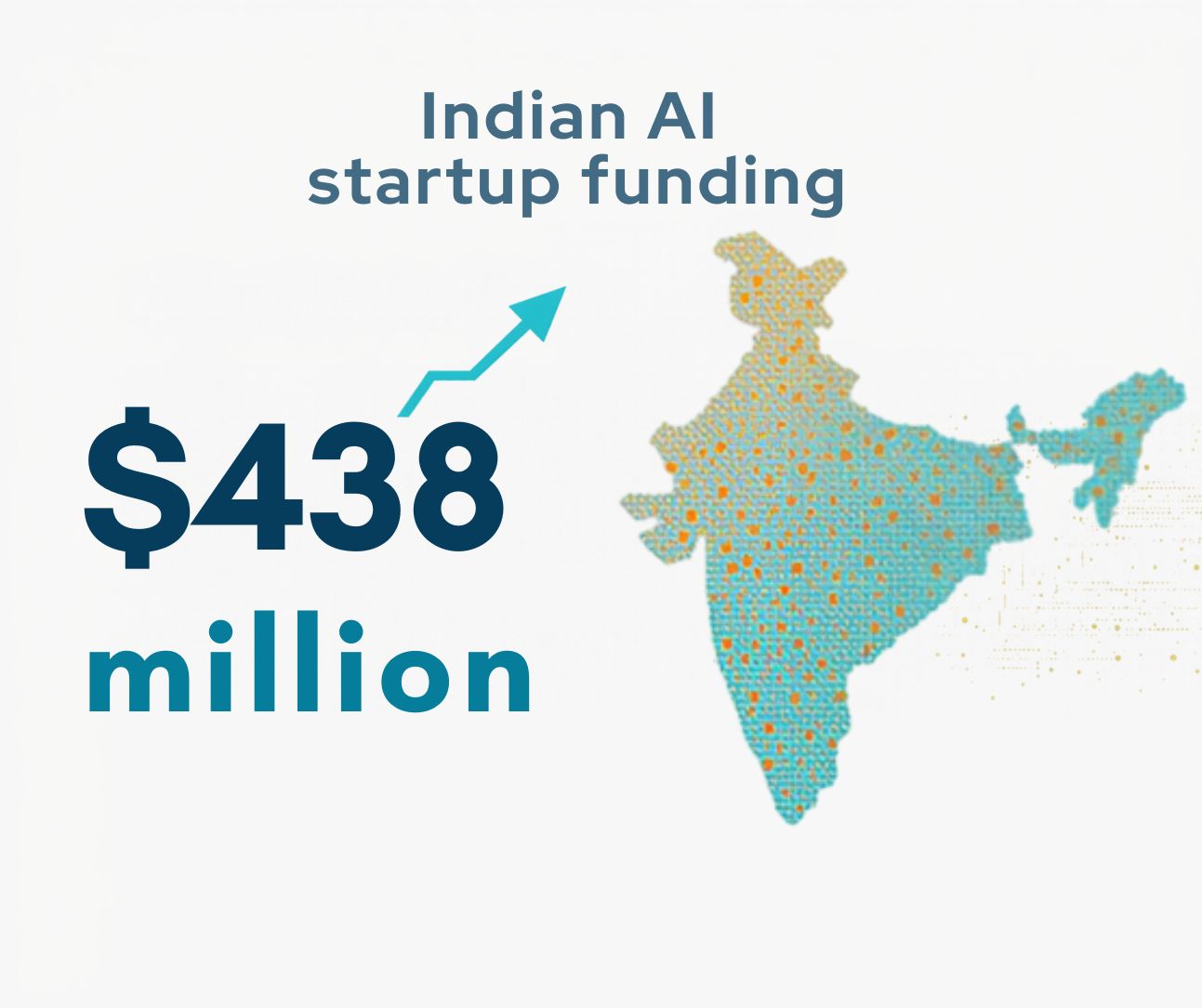
Indian AI startups raised $438 million in Q3 2026, taking total funding beyond $1.1 billion in the first nine months of the year. Here’s what the latest investment trends mean for India’s AI ecosystem.
According to Inc42’s Indian Tech Startup Funding Report Q3 2026, Indian AI startups raised $438 million across 35 funding deals between July and September 2026. That represents a 265% increase in funding compared with the same quarter last year, while the number of deals rose from 26 to 35.
The latest figures bring total funding for Indian AI startups to more than $1.1 billion during the first nine months of 2026. The sector has emerged as one of the strongest investment categories in the country’s startup landscape, even as funding across the wider ecosystem remains relatively subdued.
For founders, investors and technology businesses, the numbers point to an important shift. AI is no longer attracting attention simply because it is a promising technology. Investors increasingly want to see how it can solve specific business problems, generate recurring revenue and build a lasting competitive advantage.
AI Emerges as a Leading Sector for Indian Startup Investment
The rise in AI funding stands out against a more restrained venture capital environment.
Indian startups collectively raised approximately $2.2 billion across 210 deals in the third quarter of 2026, according to Inc42. Although the total was 5% higher than a year earlier, the number of deals declined by 13%. Overall funding also remained below the $3.4 billion recorded in the third quarter of 2024 and the eight-quarter average of approximately $2.7 billion.
AI followed a different trajectory.
The sector raised $676 million across 57 deals in the first half of 2026, more than four times the $162 million secured during the corresponding period in 2025. The additional $438 million raised in Q3 strengthened that momentum, placing AI among the most closely watched segments of India’s technology startup ecosystem.
A significant contributor to the quarter was Emergent, which raised $130 million at a reported valuation of $1.5 billion. The transaction highlighted investor appetite for AI businesses with the potential to scale quickly and serve a growing market.
However, the headline funding total does not tell the entire story. A handful of large transactions can substantially increase a sector’s aggregate investment figures without necessarily indicating that funding has become easier to access for early-stage founders.
This distinction will matter as startups seek capital in the final quarter of 2026.
Cleantech and Advanced Technology Also Attract Investors
AI was not the only segment to record strong growth during the quarter. Other technology-driven industries also attracted significant investor interest, suggesting that capital is moving towards businesses addressing industrial, environmental and infrastructure challenges.
Cleantech startups raised approximately $433 million in Q3, a year-on-year increase of 267%. Advanced hardware and technology businesses, including robotics, semiconductors and aerial vehicles, secured around $290 million, up 176%.
By comparison, fintech funding declined 11% year over year to $249 million, while ecommerce investment fell 31% to $245 million.
The contrast suggests that investors are becoming more selective about where they deploy capital. Sectors with clear technological differentiation, opportunities for long-term growth or the potential to solve complex operational problems are attracting attention, although individual companies still need to demonstrate their commercial value.
For Indian founders, this creates opportunities beyond conventional consumer technology. Businesses developing AI applications for manufacturing, healthcare, agriculture, financial services and logistics could benefit as enterprises look for practical ways to improve productivity and manage costs.
Investors Are Becoming More Careful About AI Valuations
Despite the funding surge, investor confidence is not without reservations.
Inc42’s Indian Investor Ranking and Sentiment Survey, based on responses from more than 85 institutional investors, found that approximately 63% of respondents believed Indian AI startup valuations showed some degree of froth.
Among investors who expressed concerns about valuations, around half expected a correction within the following 18 months. Another 31% viewed valuations as somewhat elevated but supported by genuine revenue opportunities.
The findings highlight the difference between enthusiasm for AI as a technology and confidence in the prices being paid for individual businesses.
Pranav Obhrai, founding and managing partner at Atrium Ventures, noted that AI valuations are influenced by a broader global trend, particularly in the United States. At the pre-seed stage, a company’s valuation may depend more on its funding requirements, perceived future potential and the dilution accepted by founders than on existing revenue or profitability.
For example, a company raising $3 million in exchange for 20% equity would have a post-money valuation of $15 million, assuming the investment is priced on those terms.
Such valuations can be reasonable when a startup has a strong product, a credible market opportunity and a convincing path to growth. They can also become difficult to justify if customer adoption, revenue and commercial progress fail to match expectations.
For founders, the message is straightforward: a compelling AI proposition may attract investor meetings, but sustainable business performance will ultimately determine whether that interest translates into long-term investment.
Which AI Businesses Are Most Likely to Attract Funding?
Investor interest is also becoming more focused on the types of AI businesses capable of creating measurable value.
In Inc42’s survey, vertical AI applications across industries such as banking and financial services, healthcare, defence and agriculture emerged as the leading category. Approximately 39% of investors expected these applications to capture the greatest value over the next five years.
AI hardware and semiconductors ranked second, attracting 23% of investor preferences. AI-led IT and business services accounted for 18%, while Indian-language and sovereign foundation models received 14%.
Data, tooling and evaluation, along with AI infrastructure and computing, each received 3%.
The results suggest that investors see substantial potential in AI products built for clearly defined industries and customer needs.
A healthcare AI startup that helps hospitals automate administrative work, for instance, may have a more direct route to demonstrating business value than a company attempting to develop a foundation model requiring significant computing resources and prolonged investment.
Similarly, AI products designed for Indian languages, regional businesses and industry-specific workflows could benefit from local market knowledge and distribution networks.
That does not mean foundational AI research lacks commercial potential. Rather, it reflects the substantial capital, technical expertise and time often required to compete in that segment.
Why Distribution Could Become a Competitive Advantage
Technology alone may not be enough to protect an AI startup from competition.
Obhrai has argued that distribution is particularly important in India, where businesses may find it difficult to defend their market position through technology alone when competing with global companies.
An AI product can be technically impressive, but its commercial prospects depend on whether customers can find it, trust it, integrate it into existing operations and continue paying for it.
This makes customer relationships, industry partnerships, sales networks and a clear understanding of local requirements increasingly important.
For early-stage founders, the implication is that product development and distribution need to advance together. Building a capable AI tool is only one part of creating a sustainable company. The other is finding a repeatable way to reach customers and demonstrate why the product is worth paying for.
Investors are also examining the economics of companies developing foundation models and AI infrastructure. These businesses can require substantial upfront spending and may operate with limited or negative gross margins while scaling.
For venture capital firms with comparatively smaller investment pools, supporting capital-intensive businesses over extended periods can be challenging.
Application-layer startups may offer a different proposition when they can build recurring revenue around specific customer problems without having to fund the entire underlying AI infrastructure themselves.
Can India’s AI Funding Momentum Continue in Q4 2026?
India’s AI investment outlook remains promising, but the pace of funding will depend on more than another round of large investments.
Several factors could support continued growth. Enterprises are moving beyond initial AI experiments towards production use cases, while investment in computing infrastructure and efforts to develop domestic AI capabilities are expanding the opportunities available to startups.
Demand for specialised applications could also create room for smaller companies to compete in areas where they understand customer needs better than general-purpose technology providers.
At the same time, Indian AI startups face a considerable funding gap compared with some of their global counterparts. Companies building large models and infrastructure must compete with businesses backed by substantially greater financial resources.
A correction in global AI valuations could also influence investor sentiment in India, particularly if highly valued companies struggle to convert their growth into revenue or sustainable margins.
For startups preparing to raise capital in the final months of 2026, demonstrating customer traction, recurring revenue, efficient operations and a defensible market position could become increasingly important.
Investors are likely to look beyond headline growth rates and examine how much capital a business needs to reach profitability, whether customers are willing to pay for its products and how easily competitors could replicate its offering.
What the Funding Surge Means for India’s Startup Ecosystem
The third-quarter figures confirm that AI has become an important force in Indian startup investment. Raising more than $1.1 billion in the first nine months of 2026 represents a significant milestone for the sector.
However, the next phase of growth may be more demanding than the current funding numbers suggest.
Founders will need to balance ambitious product development with commercial discipline. Investors will have to distinguish between businesses with genuine long-term potential and those benefiting primarily from enthusiasm surrounding AI. Enterprise customers, meanwhile, will increasingly expect measurable results rather than promises about what the technology might eventually deliver.
For India’s startup ecosystem, the opportunity lies in building AI companies that can compete internationally while addressing practical challenges in domestic and global markets.
The funding surge has given the sector considerable momentum. Whether that momentum continues into 2027 will depend on the quality of the businesses being built, the revenue they generate and their ability to turn investor confidence into lasting commercial success.
Most Asked Questions About Indian AI Startup Funding
1. How much funding did Indian AI startups raise in Q3 2026?
Indian AI startups raised $438 million across 35 deals between July and September 2026, representing a 265% year-on-year increase, according to Inc42.
2. How much funding did Indian AI startups raise in 2026?
Indian AI startups raised more than $1.1 billion during the first nine months of 2026. This includes $676 million in the first half and another $438 million in Q3.
3. Which AI startup raised a major funding round in Q3 2026?
Emergent raised $130 million at a reported valuation of $1.5 billion, making it one of the quarter’s notable AI funding transactions.
4. Which AI startup sectors are attracting investors in India?
Investor interest includes vertical AI applications, enterprise AI, AI hardware, semiconductors, Indian-language AI and specialised business automation. Inc42’s survey found that 39% of participating investors favoured vertical AI applications.
5. Why are investors concerned about AI startup valuations?
Some investors believe valuations have risen faster than revenue and commercial fundamentals justify. High valuations can create difficulties during future fundraising rounds if startups fail to meet growth expectations.
6. Can early-stage AI startups attract funding in India?
Yes, but funding depends on factors such as the founding team’s capabilities, customer validation, product differentiation, market opportunity and financial discipline. Funding is competitive, and the sector’s aggregate investment figures do not guarantee that individual startups will secure capital.
7. What should Indian AI founders do before approaching investors?
Founders should validate customer demand, demonstrate measurable product value, prepare realistic financial projections, understand their competitive position and explain how additional funding will support specific business milestones.
8. Will AI remain a major startup investment sector in India?
AI could continue attracting substantial investment as businesses adopt the technology, but funding levels may fluctuate. Revenue growth, customer adoption, operating costs and global investor sentiment will influence future investment decisions.
Source: Inc42’s Indian Tech Startup Funding Report Q3 2026 and Indian Investor Ranking and Sentiment Survey. Funding figures and survey findings are attributed to Inc42.