
🇮🇳 BestStartup India · Funding Report · Q1 2026
Table of Contents
India startup funding Q1 2026 tells a story not of slowdown, but of sharpening.
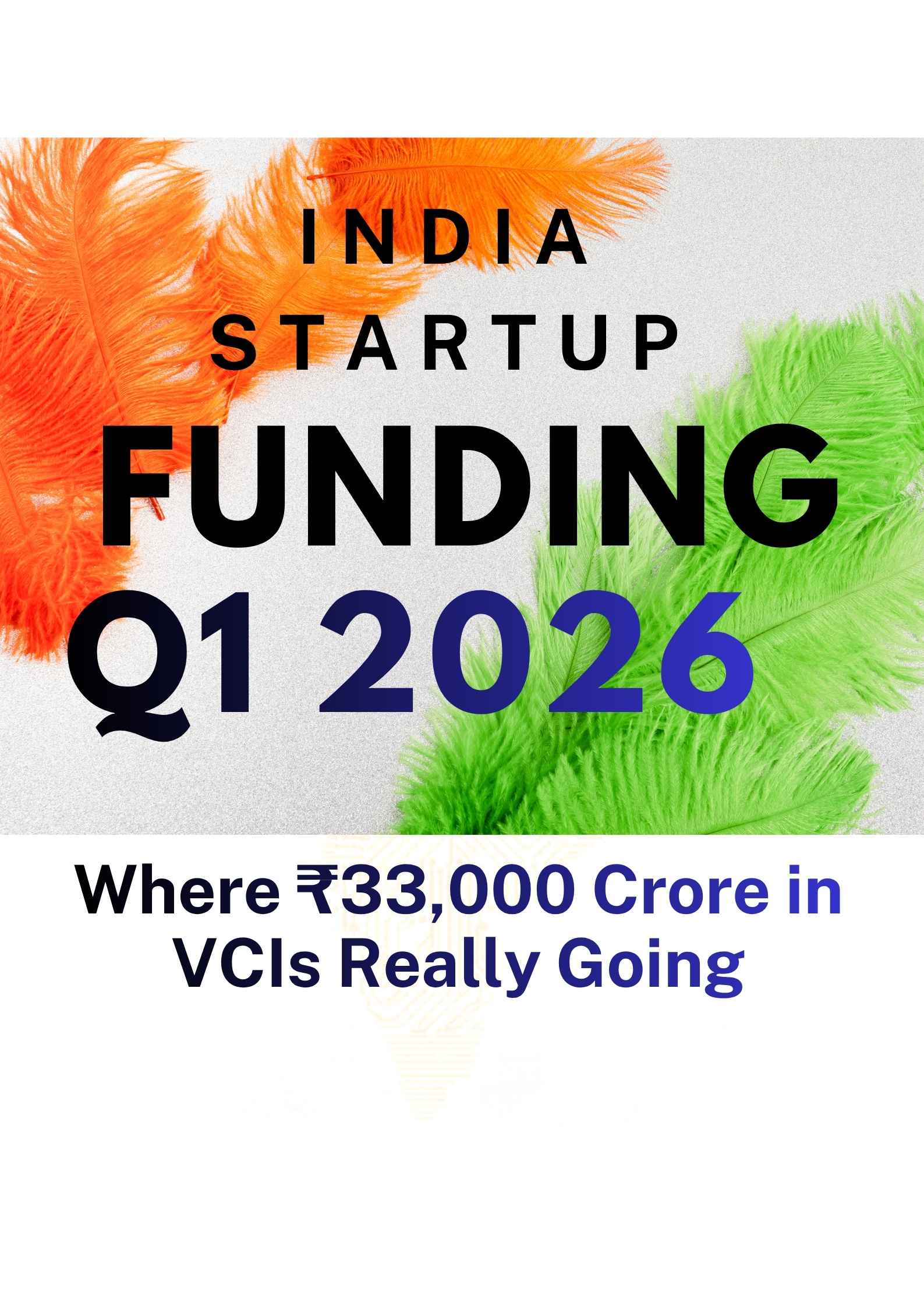
Nearly ₹33,000 crore (~$3.9 billion) flowed into Indian startups across the first three months of 2026, moving with a new kind of precision: backing fewer companies, betting bigger, and targeting sectors that are building India’s long-term competitive edge on the world stage.
India Startup Funding Q1 2026: The Full Picture
India startup funding Q1 2026 totalled approximately ₹32,800 crore (~$3.9 billion) across more than 380 deals, according to data compiled by Entrackr and Inc42. On the surface, that represents a 26% year-on-year dip compared to Q1 2025. Strip away the context-free comparison to a frothy peak period and what you find is a market that is maturing, not contracting.
Investors deployed capital with surgical intent in Q1 2026. The era of spray-and-pray venture capital — writing cheques into dozens of identical startups — is clearly over. What has replaced it is a disciplined, fundamentals-first approach where investors back proven teams, differentiated products, and businesses with a credible path to profitability. This shift is healthy for India’s startup ecosystem in the long run, even if it feels tighter for founders raising capital today.
The single most significant deal of the quarter was Neysa’s ₹10,000 crore (~$1.2 billion) Series B — the country’s largest AI funding round ever. The Bengaluru-based AI infrastructure platform builds the compute backbone for India’s AI revolution.
Neysa’s raise accounted for nearly one-third of the quarter’s total capital, making it not just a company milestone but a genuinely national one. It signals that global institutional capital is willing to make generational bets on Indian deep technology.
Beyond Neysa, the deal flow revealed other clear category winners. Weaver Services raised ₹1,300 crore (~$156 million) in affordable housing finance a reminder that India’s most fundable problems are often also its most human ones.
Arya.ag, the agritech platform connecting farmers to institutional buyers, secured ₹670 crore (~$80.3 million). EV-focused Drivn closed ₹668 crore (~$80 million) to accelerate India’s two-wheeler electrification story. Each of these deals reflects a single investor thesis: back companies solving real Bharat-scale problems with technology.
💰 Top Deals Q1 2026
- Neysa — ₹10,000 Cr · AI Infrastructure
- Weaver Services — ₹1,300 Cr · Housing Finance
- Arya.ag — ₹670 Cr · Agritech
- Drivn — ₹668 Cr · EV Mobility
📍 Funding by City
- Mumbai — ₹13,700 Cr · 34 deals
- Bengaluru — ₹10,100 Cr · 166 deals
- Delhi NCR — ₹4,490 Cr · 74 deals
Three Sectors Driving India Startup Funding in Q1 2026
Three sectors stood out in India startup funding Q1 2026 not just for capital raised, but for what they represent about India’s trajectory as a global technology power.
Artificial Intelligence: India’s Biggest Bet
AI investment surged 73% year-on-year to ₹2,110 crore (~$253 million) in Q1 2026, catapulting the sector to third place in overall India startup funding. India’s AI startups are building critical infrastructure including GPU compute clusters, vernacular large language models for 22 Indian languages, AI-powered healthcare diagnostics reaching rural districts, and industrial automation tools for factories across Pune, Surat, and Coimbatore.
The government’s GENESIS programme under the Ministry of Electronics and IT (MeitY) supports AI, quantum computing, and semiconductor design with direct grant funding.
The India AI Mission, backed by a ₹10,372 crore budget, is building sovereign compute capacity to ensure India is not dependent on foreign infrastructure for its AI future. India is on track to become one of the top three global AI markets by 2030.
Electric Vehicles: The Road to a Trillion-Rupee Market
India’s EV transition is not a future story. It is happening now, and venture capital is following. With Delhi, Maharashtra, Gujarat, and Tamil Nadu running active EV purchase subsidies, and the Production Linked Incentive (PLI) scheme backing battery cell manufacturing, EV startups enjoy a rare alignment of government intent, consumer demand, and investor appetite. India sells more two-wheelers than any country on earth and electrifying even 30% of that market represents a multi-billion dollar opportunity.
Logistics-adjacent EV plays are drawing serious institutional attention alongside pure EV manufacturers. Electric three-wheelers for last-mile delivery, EV charging infrastructure, and battery-as-a-service platforms are all attracting capital as India’s quick commerce and e-commerce sectors create demand for clean, cost-efficient urban delivery fleets.
Quick Commerce and D2C: India’s Unique Structural Advantage
Quick commerce defied global scepticism in Q1 2026. While Western markets struggled to make 10-minute delivery economics work, India’s unique density advantage creates a genuinely different equation. Over 500 million smartphone users are concentrated in high-population urban centres.
A near-universal UPI payments infrastructure processes over 18 billion transactions monthly. The world’s youngest median population of 28 years drives mobile-first consumer behaviour at scale. D2C brands across beauty, nutrition, home goods, and fashion are riding this infrastructure wave, building direct customer relationships and high-margin repeat purchase businesses that Western equivalents simply cannot replicate.
The Investor Landscape: Who Is Backing India Right Now
Peak XV Partners (formerly Sequoia India and Southeast Asia) led VC activity in Q1 2026 with 16 deals, cementing its position as India’s most active institutional investor. Lightspeed India, Blume Ventures, Accel India, and Elevation Capital all remained active, each deploying the same selective, larger-cheque approach.
Domestic family offices and high-net-worth individual syndicates stepped up meaningfully in the ₹5 crore to ₹50 crore seed range, filling the gap left by international micro-VCs that have slowed India deployment.
Bengaluru dominated deal volume with 166 transactions across the quarter. Mumbai led by total capital deployed at ₹13,700 crore driven primarily by fintech and financial services. Delhi NCR contributed ₹4,490 crore from 74 deals.
The genuinely encouraging signal: Pune, Chennai, Hyderabad, and Ahmedabad are quietly building deal volumes that suggest the next wave of Indian unicorns will emerge from beyond the traditional three metros. India’s startup capital is decentralising.
What India Startup Funding Q1 2026 Signals for the Rest of the Year
The Startup India Fund of Funds 2.0, launched by Prime Minister Narendra Modi with a ₹10,000 crore corpus, is beginning its deployment cycle through SEBI-registered Alternative Investment Funds. This is a structurally important development. Domestic capital reduces India’s vulnerability to global VC sentiment cycles driven by US Federal Reserve policy or Silicon Valley risk appetite. As Fund of Funds 2.0 capital flows through Q2 and Q3 2026, expect deal volumes to recover even if individual round sizes remain disciplined.
The IPO pipeline presents the other major catalyst. Rediff, India’s original internet company, has filed confidential IPO papers to raise ₹600 to ₹800 crore, reinventing itself as an AI-led platform with RediffPay and UPI integration. Several 2021-vintage unicorns are targeting public market debuts as their investors seek liquidity. A healthy IPO cycle in 2026 would inject fresh confidence and capital recycling into the ecosystem, funding the next generation of early-stage Indian startups.
For founders, the message from India startup funding Q1 2026 is crystal clear. Capital is available but it is disciplined. Build for India’s scale. Build for profitability from day one. Build for the long game. The investors who matter are watching and they are increasingly proud of what Indian founders are creating for Bharat and for the world. 🇮🇳
Government Grants for Indian Startups: Apply Right Now
If you are a founder inspired by India startup funding Q1 2026 and looking to build your own venture, these government schemes provide non-dilutive capital to get you started. Getting DPIIT recognition via startupindia.gov.in is the essential first step and unlocks access to every scheme below.
| Scheme | Amount | Best For | Apply |
|---|---|---|---|
| Startup India Seed Fund (SISFS) | Up to ₹20L grant + ₹50L convertible debt | Early-stage DPIIT-recognised startups | startupindia.gov.in |
| SIDBI Fund of Funds 2.0 | ₹10,000 Cr corpus via AIFs | Series A and beyond via eligible VC funds | sidbi.in |
| Karnataka Elevate Grant | Up to ₹50L, zero equity taken | Karnataka-based startups of any sector | startup.karnataka.gov.in |
| TANSEED 6.0 Tamil Nadu | ₹10L milestone-based disbursement | Tamil Nadu startups including climate-tech | startuptn.in |
| MahaFund Maharashtra | ₹500 Cr state corpus | Maharashtra early-stage startups | startup.maharashtra.gov.in |
| Telangana Startup Fund | ₹1,000 Cr corpus via T-Hub | Hyderabad and Telangana startups | t-hub.co |
Frequently Asked Questions about India Startup Funding Q1 2026
How much did Indian startups raise in Q1 2026?
India startup funding Q1 2026 totalled approximately ₹32,800 crore (~$3.9 billion) across more than 380 deals. The largest single round was Neysa’s ₹10,000 crore (~$1.2 billion) Series B — India’s biggest AI funding round ever. Total funding was down 26% year-on-year, reflecting a more selective but fundamentally healthier investment climate.
Which sectors got the most startup funding in India in Q1 2026?
The top sectors by India startup funding in Q1 2026 were Artificial Intelligence (up 73% year-on-year to ₹2,110 crore), Electric Vehicles and Mobility, Fintech, Quick Commerce, and Affordable Housing Finance. Deeptech overall saw the sharpest growth in investor attention, supported by government programmes like GENESIS and the India AI Mission.
Which city received the most startup funding in India in Q1 2026?
Mumbai led by total capital deployed at ₹13,700 crore (~$1.64 billion), driven primarily by fintech and financial services. Bengaluru led by deal count with 166 transactions, cementing its position as India’s startup capital. Delhi NCR was third with ₹4,490 crore (~$538 million) across 74 deals.
What was the biggest startup funding deal in India in Q1 2026?
The biggest deal in Q1 2026 was Neysa’s ₹10,000 crore (~$1.2 billion) Series B — the largest AI funding round in Indian startup history. Neysa is a Bengaluru-based AI infrastructure platform building the compute backbone for India’s AI ecosystem. The round alone represented nearly one-third of all India startup funding in the quarter.
How can early-stage Indian startups get government funding in 2026?
Early-stage Indian startups can access government funding through three key schemes: the Startup India Seed Fund Scheme (SISFS) offering up to ₹20 lakh as a grant and ₹50 lakh as convertible debt; SIDBI Fund of Funds 2.0 (₹10,000 crore corpus); and state-level grants like Karnataka Elevate, TANSEED 6.0, and T-Hub offering up to ₹50 lakh with no equity dilution. DPIIT recognition is required for most central schemes.
Is India a good country for startups in 2026?
Yes — India is one of the world’s top three startup ecosystems in 2026, with over 1.5 lakh DPIIT-recognised startups, 117+ unicorns, and nearly ₹33,000 crore in VC funding in Q1 2026 alone. India’s combination of 1.4 billion consumers, a world-class digital payments infrastructure (UPI), young median population, and strong government support through Startup India, PLI schemes, and the India AI Mission makes it a uniquely compelling environment for founders.
Sources: Inc42 Q1 2026 Funding Report · Entrackr Quarterly Report · LAFFAZ Sector Analysis · StartupIndia.gov.in · SIDBI