

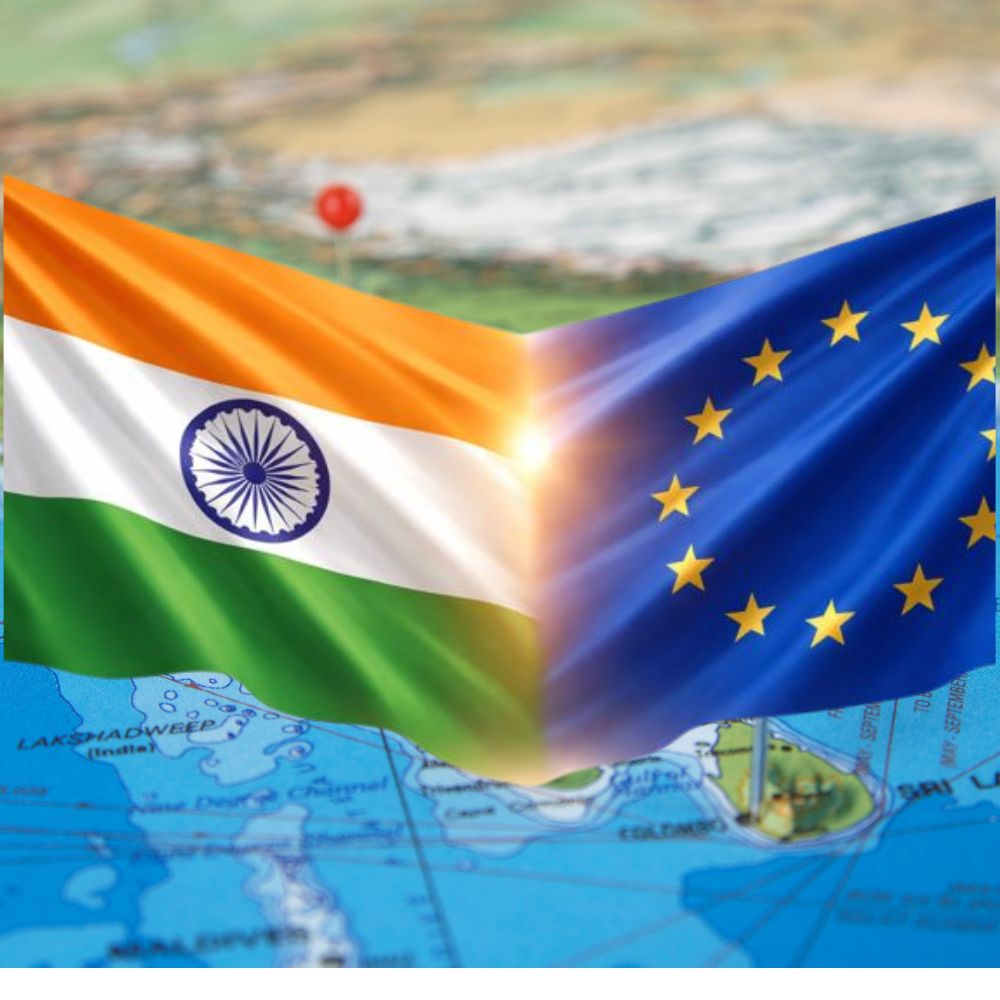
The India-EU Free Trade Agreement 2026 was officially signed at the India-EU Summit 2026 in New Delhi, marking one of the most transformative trade milestones of recent decades.
Table of Contents
Prime Minister Narendra Modi hailed the agreement as the “mother of all trade deals,” emphasizing that it will strengthen investor confidence, expand India’s manufacturing capacity, and unlock substantial opportunities for the services and technology sectors.
Bringing together two major economic blocs that represent nearly 25% of global GDP and one-third of global trade, the agreement creates a market of almost two billion people. For India, this landmark pact signals a decisive shift toward deeper global integration at a time when trade fragmentation and protectionism are rising worldwide.
What the India-EU Free Trade Agreement 2026 Means for Trade and Investment
Under the new agreement, tariffs on over 90% of European goods exported to India will be abolished or significantly reduced through phased implementation. In some categories, tariff elimination will reach as high as 96.6%, making this one of the most ambitious trade liberalization initiatives in India’s history.
Key sectors expected to benefit include:
- Automobiles and automotive components
- Machinery and engineering goods
- Chemicals and pharmaceuticals
- Clean energy equipment
- High-end manufacturing
European carmakers, for instance, will see import duties significantly reduced from previous levels exceeding 100%, opening new opportunities in India’s automotive market.
Conversely, Indian exporters will gain improved access to EU markets for textiles, engineering goods, pharmaceuticals, and professional services, bolstering India’s role in global value chains and enhancing its competitiveness in high-value sectors.
India-EU Summit 2026: Beyond Trade
The India-EU Summit 2026 focused on far more than just trade. Leaders agreed to deepen collaboration in technology, defense, digital infrastructure, and supply chain resilience. Union Defence Minister Rajnath Singh described the partnership as a “formidable alliance for the world,” reflecting shared geopolitical and economic priorities.
European Commission President Ursula von der Leyen and European Council President Antonio Costa, on a state visit to India, highlighted that the agreement is designed to create predictable, transparent, and rules-based trade conditions for businesses on both sides.
According to the European Commission’s official trade data, the EU is already India’s largest trading partner, accounting for €120 billion in trade in goods in 2024, while being a leading source of foreign direct investment (FDI) in India. More details can be found on the European Commission’s India trade page.
Why the ‘Mother of All Deals’ Attracts Global Attention
The India-EU trade deal has drawn widespread international attention, particularly from the United States, amid rising global protectionism and tariff tensions. Analysts view the pact as part of a broader strategic push by major economies to diversify trade partnerships and reduce dependence on any single market.
Trade between India and the EU has grown nearly 90% over the last decade, and the new agreement is expected to accelerate this momentum. With over 6,000 European companies already operating in India, the deal is likely to attract fresh investments in manufacturing hubs, green technology, and advanced services.
Economic and Strategic Implications
The India-EU FTA 2026 is expected to:
- Boost investor confidence in India as a global manufacturing hub
- Promote India’s services sector, including IT, professional services, and fintech
- Enhance India’s participation in global value chains, particularly in high-tech industries
- Encourage European investments in clean energy, infrastructure, and industrial projects
- Strengthen geopolitical ties between two strategic partners in a rapidly shifting global order
For Europe, the agreement ensures deeper access to one of the world’s fastest-growing major economies and reinforces EU engagement in the Indo-Pacific region.
Phased Implementation and Next Steps
Although the Free Trade Agreement has been signed, implementation will follow a phased roadmap:
- Gradual tariff reductions across multiple sectors
- Regulatory adjustments for both trade and investment
- Sector-specific commitments for automotive, pharmaceuticals, chemicals, and clean energy
In addition to the FTA, separate negotiations on investment protection and geographical indications are expected to progress alongside the main framework, providing legal clarity and protection for businesses on both sides.
Sector-Specific Benefits
Automobiles: Indian import duties on European cars will fall sharply, encouraging technology transfer and joint ventures.
Manufacturing and Machinery: Reduced tariffs will enhance Europe-India supply chains, promoting industrial collaboration.
Pharmaceuticals and Chemicals: Easier access to EU markets will allow Indian companies to scale exports while maintaining high quality standards.
Services and IT: Indian IT and business services firms will benefit from streamlined access to European clients, boosting competitiveness.
Clean Energy: Cooperation in solar, wind, and battery technologies will accelerate India’s renewable energy ambitions while opening European investment opportunities.
Geopolitical and Strategic Importance
The India-EU FTA is more than a trade deal; it represents a strategic partnership in a complex global landscape:
- Supports rules-based international trade under WTO norms
- Strengthens defense and security collaboration, including interoperability in defense supply chains
- Enhances technology sharing and critical infrastructure cooperation
- Signals India’s commitment to global trade integration while balancing relations with major economies
FAQs
What is the India-EU Free Trade Agreement 2026?
A comprehensive pact aimed at reducing tariffs, improving market access, and strengthening economic cooperation between India and the EU.
Why is it called the ‘mother of all trade deals’?
Because it covers a quarter of global GDP, one-third of global trade, and strategic sectors including manufacturing, technology, and services.
When will the agreement take effect?
Phased implementation will begin after ratification and regulatory alignment by both sides.
Which sectors benefit the most?
Automobiles, manufacturing, chemicals, pharmaceuticals, clean energy, services, and technology.
Where can I find official EU trade data?
European Commission’s India trade page provides official statistics, agreements, and updates.
The India-EU Free Trade Agreement 2026 marks a historic milestone in global commerce, reinforcing India’s role as a key player in international trade while providing Europe with long-term access to a fast-growing market. The deal is expected to transform sectors ranging from manufacturing and automobiles to technology and clean energy, creating opportunities for businesses, investors, and consumers alike.
This landmark agreement, hailed as the ‘mother of all trade deals’, signals a broader strategic alignment and economic cooperation between India and Europe, setting the tone for a new era of trade, investment, and partnership.
Follow BestStartup India for more startup, investment, and ecosystem insights.