

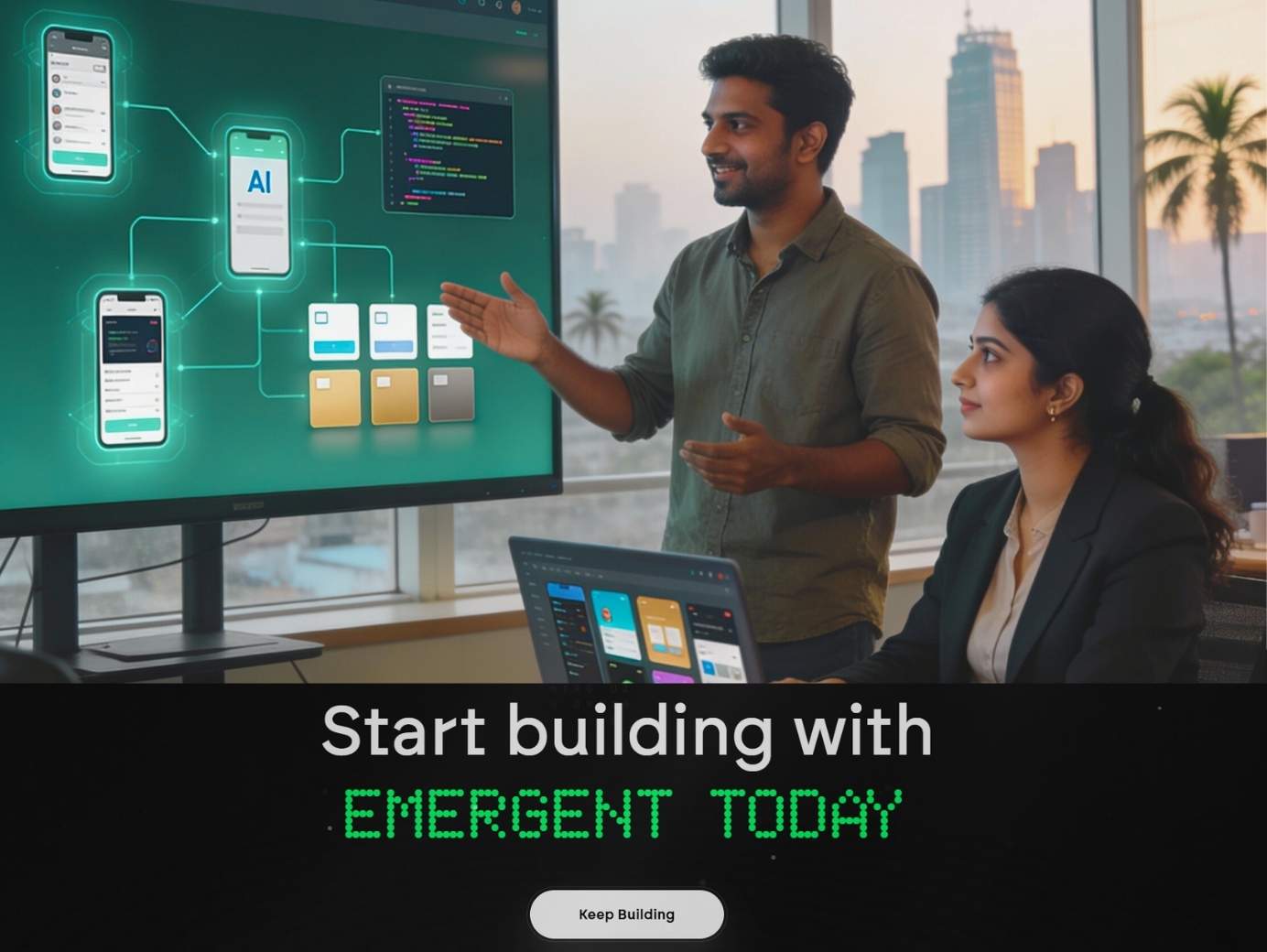
The Dawn of the Idea-First Economy
As we navigate the opening days of 2026, a profound transformation is occurring within the Indian technological landscape. For decades, the greatest hurdle to starting a digital business was the “Technical Barrier.” Thousands of brilliant Indian minds students in small towns, social workers in rural districts, and visionary entrepreneurs in our bustling metros had ideas that could solve real-world problems.
However, they were consistently held back by a single, daunting question: “How do I build the software?”
Historically, the answer involved spending lakhs of rupees on development agencies or spending years mastering the syntax of complex programming languages. Emergent AI 2026 has arrived as the definitive, visionary answer to that historical struggle.
Table of Contents
This India no-code software startup is not merely building a tool; it is launching a social and economic movement.By shifting the startup equation from “code-first” to “idea-first,” Emergent AI opens doors for anyone with a clear vision
In this new era, your ability to innovate is no longer determined by your ability to write Python or Java. It is determined by the clarity of your vision and your understanding of the human problem you wish to solve.
By allowing anyone to build production-grade software through natural, human conversation, Emergent AI is ensuring that in 2026, the best idea wins.
The Visionary History of Mukund and Madhav Jha
The history of Emergent AI is more than just a corporate timeline; it is a story of professional excellence and the unique synergy between twin brothers, Mukund and Madhav Jha. Their journey serves as a powerful testament to the impact of returning to one’s roots to solve global problems with local empathy.
Mukund Jha, the CEO, is a seasoned architect of scale. His professional history includes a high-impact tenure at Google, where he learned the rigors of global software standards. However, his most defining experience in the Indian context was his role as the co-founder and CTO of Dunzo. At Dunzo, Mukund navigated the high-pressure, chaotic, and beautiful world of Indian logistics. He saw firsthand that the biggest bottleneck for any startup wasn’t a lack of ideas—it was the speed of technical execution. He watched as brilliant features that could help thousands of delivery partners were delayed by weeks due to coding complexities. He realized that the world needed a “shortcut” that didn’t compromise on quality.
Madhav Jha, the CTO, provided the deep-tech soul for this mission. With a PhD in Theoretical Computer Science, Madhav’s history is rooted in the academic elite. He served as a von Neumann fellow and was a lead researcher at Amazon SageMaker, the very platform that powers much of the world’s modern machine learning. While Mukund understood the founder’s daily struggle, Madhav understood the machine’s hidden potential.
The brothers reconnected in 2025 with a shared mission: to democratize the power of the machine. They combined Mukund’s operational grit with Madhav’s theoretical mastery to create a platform that feels like magic but is built on solid science. Their connection is the reason Emergent AI 2026 is the most trusted name in the ecosystem today; it is built on a decade of top-tier experience at the intersection of Silicon Valley and Bengaluru.
The Human Story Behind Agentic Vibe-Coding
When we discuss “Vibe-Coding,” we are not referring to simple drag-and-drop templates or basic website builders. We are talking about a fundamental shift in the human-computer relationship. Most people think of software as a series of rigid, cold instructions. The Jha brothers, however, saw software as an expression of human intent.
The platform functions through what is known as “Agentic AI.” Unlike older AI that simply guessed the next word in a sentence, these agents can reason, plan, and execute. Imagine sitting down and describing a dream:
“I want an app that helps small-scale organic farmers in Maharashtra track their soil health using IoT sensors and connects them directly to premium buyers in Mumbai, with a Marathi voice-first interface for the farmers.”
In the background, Emergent’s AI agents don’t just search for a template. They act as a digital architect, a backend engineer, and a security expert simultaneously. They design the database, secure the payment gateways, and craft a user experience that feels native to the user’s specific cultural and business context. This is why this India no-code software startup is being cherished by young entrepreneurs. It respects the complexity of their vision while lifting the heavy burden of execution.
A Strategic Future Backed by Google
The rise of Emergent AI 2026 has been supported by a “who’s who” of global venture capital, providing the startup with the “oxygen” needed to scale. After achieving a record-breaking $25 million ARR run rate within months of launch, the startup secured a massive $23 million Series A. This round was led by Lightspeed Venture Partners and supported by Prosus Ventures and Y Combinator.
However, the most visionary moment in their history was the strategic partnership with the Google AI Futures Fund. This was more than just a financial transaction. It granted the Jha brothers early, privileged access to the world’s most advanced foundational models, including the latest iterations of Gemini.
This partnership ensures that every application built on the Emergent platform is powered by the same world-class intelligence that drives global technology giants. For a young founder in India, this means their “no-code” app is actually more sophisticated and secure than many custom-coded apps of the past. It provides a level of reliability that makes this platform the gold standard for emergent startups in the 2026 landscape.
Impact on the Young Indian Entrepreneurial Ecosystem
The true success of Emergent AI 2026 is not measured in dollars, but in the stories of the people it empowers. In the past, a young student with a revolutionary idea for an EdTech platform would have to spend their college years searching for a technical co-founder. Often, they would have to give away 40% to 50% of their company just to get a basic version of their product live.
Today, that student is a “Solo-Premium” founder. They can maintain 100% ownership of their vision because they have an AI engineering team at their fingertips. We are seeing a surge in “Indie Hackers” across India—individuals who are running profitable software businesses from their bedrooms in cities like Indore, Kochi, and Chandigarh.
By removing the “gatekeepers” of technology, Emergent AI is fostering a more inclusive and diverse startup culture. It is allowing the “Next Billion” users to not just participate in the digital economy, but to architect it.
Democratizing the “SaaS” Dream: From Local to Global
One of the most exciting trends we are covering at beststartup.india is the rise of Micro-SaaS. These are small, highly specialized software companies that solve very specific problems. Previously, the high cost of development made Micro-SaaS unviable in India. You couldn’t justify spending 10 lakhs to build a tool that only made 50,000 rupees a month.
With Emergent AI, the cost of development has dropped by 90%. Now, an entrepreneur can build ten different small tools, see which one sticks, and scale the winner. This “fail-fast” mentality is exactly what India needs to become a global innovation hub. We are seeing Indian founders building tools for the global market—selling software to users in the US, Europe, and Japan—all built without a single line of manual code.
The Roadmap to 2030: Empowerment for Every Indian
As we look toward the horizon, the vision for Emergent AI 2026 is one of total, unconditional empowerment. Mukund and Madhav Jha are building toward a world of “Zero-Friction Innovation.” They believe that by 2030, the ability to create software will be as common and as intuitive as the ability to send a text message.
This is a call to action for every young entrepreneur, every student, and every dreamer across our nation. The tools for your success are no longer locked behind the walls of elite universities or high-priced engineering firms. You can start your journey today at Emergent.sh and witness for yourself how your ideas can take flight.
The story of Emergent AI is the story of India’s digital future—optimistic, inclusive, and boundary-less. It is a history that we are writing together, one app at a time.
For more deep dives into the Indian AI startup ecosystem and the latest updates on startup funding in India, stay tuned to our platform. We are committed to bringing you the stories of the visionaries who are building the India of tomorrow.
Follow Best Startup India for more information on the companies and founders who are transforming our nation.
Frequently Asked Questions
Q1: What exactly is Emergent AI 2026? Emergent AI 2026 is a premier India no-code software startup that utilizes agentic artificial intelligence to build full-stack, production-ready applications through natural language conversations, a revolutionary process known as “vibe-coding.”
Q2: Who are the founders of Emergent AI and what is their background? The company was founded by twin brothers Mukund Jha (CEO) and Madhav Jha (CTO). Mukund is a former Google engineer and co-founder/CTO of Dunzo, while Madhav holds a PhD in Computer Science and was a lead researcher at Amazon SageMaker.
Q3: How much does it cost to start building on Emergent AI? The platform offers an incredibly accessible entry point at Emergent.sh, including a free tier that allows students and young innovators to prototype and deploy their initial ideas without any upfront financial investment.
Q4: Is software built with no-code tools secure enough for real business? Yes. Because Emergent AI 2026 is backed by the Google AI Futures Fund and uses high-level agentic reasoning, the code it generates follows modern security protocols and industry standards, often making it more secure than manually written code from junior developers.
Q5: What is the significance of the “vibe-coding” terminology? “Vibe-coding” refers to a shift where the user provides the “intent” or “vibe” of the application in plain language, and the AI agents handle the technical translation into database schemas, API calls, and frontend code.