

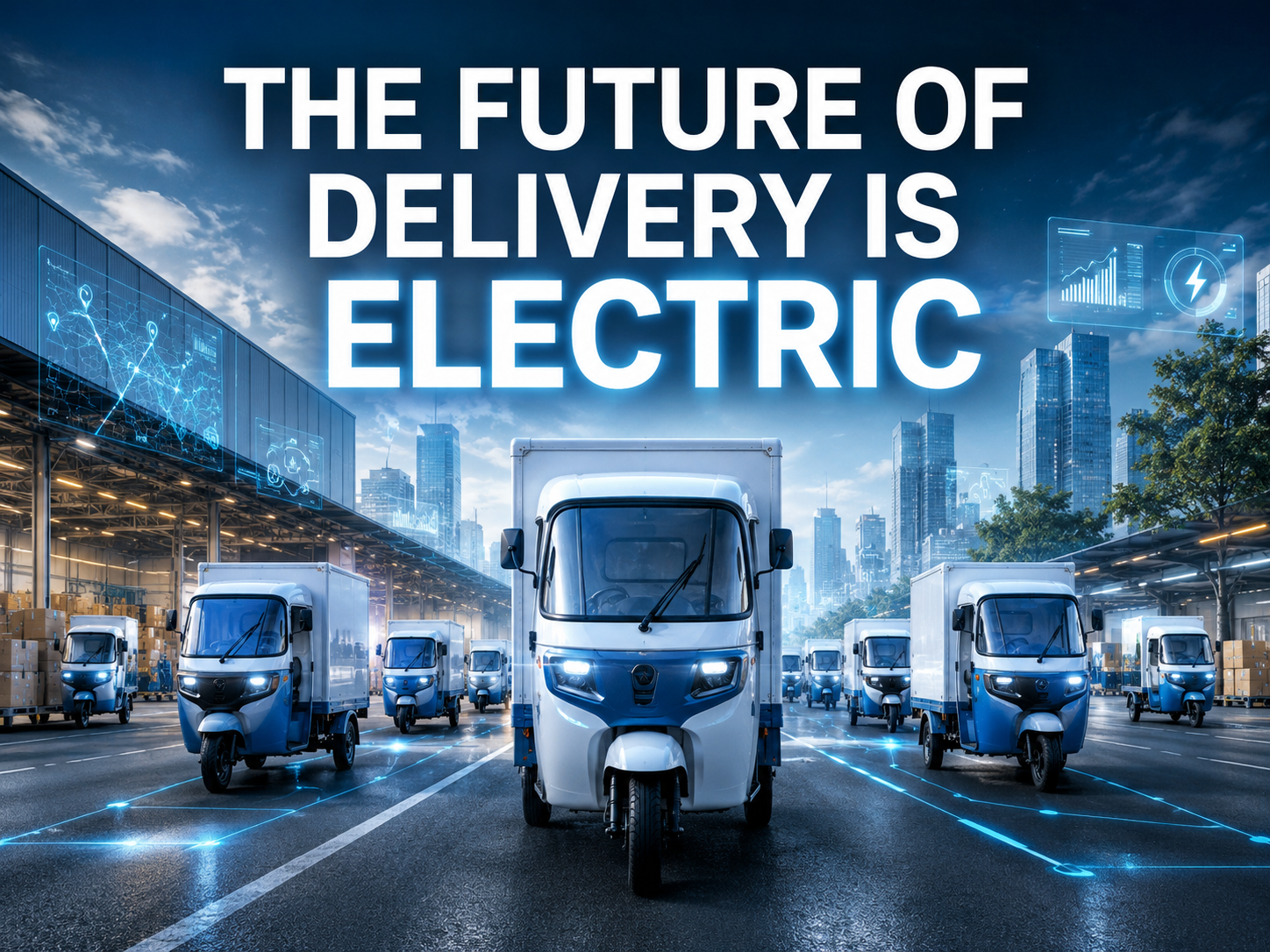
India’s shift toward electric mobility is no longer limited to passenger vehicles. Logistics companies are now making significant investments in electric fleets, and Delhivery is among the latest to accelerate that transition.
The Gurugram-based logistics company has partnered with Bajaj Auto to deploy 200 Bajaj RIKI eCarts across its delivery network. The rollout marks the first phase of a larger plan that could see as many as 1,500 electric three-wheelers operating across Delhivery’s network by 2027.
The announcement comes at a time when ecommerce growth is expanding beyond major cities and into smaller towns, creating new challenges for delivery companies. Rising fuel costs, growing environmental concerns, and increasing customer expectations are forcing logistics providers to rethink how goods move through India’s rapidly evolving supply chain.
For Delhivery, the answer appears to be a combination of electric mobility and technology.
What Is Delhivery’s Electric Vehicle Initiative?
The first batch of vehicles has already been flagged off from Bajaj Auto’s facility in Pune and will gradually become part of Delhivery’s last-mile delivery operations. While many electric vehicle programs in India have focused primarily on metro cities, this partnership is expected to extend into Tier-2 and Tier-3 markets as well, where ecommerce demand continues to grow at a rapid pace.
The vehicles being deployed are the Bajaj RIKI C4005 eCart, a cargo-focused electric three-wheeler built specifically for urban and semi-urban delivery work. According to Bajaj Auto, the vehicle can travel more than 100 kilometres on a single charge and features a two-speed automatic transmission designed to reduce driver fatigue on longer routes.
Why Delhivery Is Betting on Electric Mobility
The economics behind the decision are straightforward. Traditional fuel-powered delivery vehicles come with rising petrol and diesel costs, frequent maintenance visits, and growing regulatory pressure in urban areas. Electric cargo vehicles address all three.
For Delhivery, this is not just an environmental commitment — it is a business decision. Lower operating costs per vehicle, reduced dependence on fuel price fluctuations, and alignment with India’s national electric mobility goals all make the case for fleet electrification compelling.
The company has also been clear that the 200-vehicle rollout is a starting point, not an endpoint. Scaling to 1,500 electric three-wheelers by FY 2026-27 would represent one of the largest commercial EV deployments in India’s logistics sector.
What the Bajaj RIKI eCart Brings to Last-Mile Delivery
The Bajaj RIKI C4005 eCart is not a general-purpose vehicle repurposed for logistics. It has been designed from the ground up with cargo transportation in mind.
Beyond its 100-kilometre range, the vehicle offers improved cargo capacity, reduced vibration for smoother urban driving, and lower maintenance requirements compared to conventional alternatives. For delivery partners who operate these vehicles daily, those features translate directly into lower costs and fewer disruptions.
That matters in a sector where delivery partners often operate on thin margins. Reduced fuel and maintenance expenses can meaningfully improve earnings over time, which also helps logistics companies retain drivers in a competitive market.
Tier-2 and Tier-3 Cities Are Central to the Plan
One of the more significant aspects of this partnership is its geographic ambition. Ecommerce growth in India is increasingly being driven by smaller cities and towns, where consumers are ordering online at rapidly growing rates but infrastructure and delivery economics remain more challenging.
Deploying electric vehicles in these markets is not without its complexities. Charging infrastructure in Tier-2 and Tier-3 cities is still developing, and range requirements can vary significantly across different operating environments.
Delhivery’s approach combining electric vehicles with its existing route optimisation and logistics management technology — is designed to address these challenges. By using data to plan delivery routes more efficiently, the company aims to maximise vehicle range while keeping delivery timelines competitive.
Technology as the Force Multiplier
Delhivery has consistently positioned itself as a technology-first logistics company, and that framing extends to how it is approaching fleet electrification.
The company plans to integrate the new electric vehicles with its existing route optimisation systems, which use machine learning to identify the most efficient delivery paths in real time. This combination of electric mobility and intelligent logistics planning is intended to improve deliveries per trip, reduce energy consumption, and lower overall operating costs across the network.
It is an approach that reflects a broader trend in Indian logistics, where the most competitive companies are those that can combine operational scale with technological sophistication.
What This Means for India’s EV Sector
For Bajaj Auto, the partnership with Delhivery provides meaningful commercial validation for the RIKI eCart platform in a high-volume, demanding logistics environment. Success here could accelerate adoption across other logistics and ecommerce companies evaluating similar transitions.
India’s government has been actively encouraging electric vehicle adoption through a combination of subsidies, favourable policies, and charging infrastructure investment. Commercial fleet operators like Delhivery are increasingly seen as key drivers of that transition, given the volume of vehicles they operate and the frequency with which those vehicles are on the road.
If Delhivery successfully scales to 1,500 electric vehicles by 2027, the cumulative impact on urban emissions and fuel consumption across its delivery network would be substantial.
The Road Ahead
The deployment of 200 eCarts may be an early step, but it signals a clear direction. Delhivery is building toward a logistics network that is faster, more efficient, and increasingly powered by electricity rather than fuel.
For the broader Indian logistics sector, this partnership offers a practical model for how fleet electrification can be approached — starting with a manageable initial deployment, proving the economics, and then scaling with confidence.
As ecommerce continues to grow and environmental expectations rise, initiatives like this are likely to become the norm rather than the exception across India’s delivery landscape.
Frequently Asked Questions
1.How many electric vehicles is Delhivery deploying?
Delhivery has deployed 200 Bajaj RIKI eCarts in the first phase, with plans to scale the electric fleet to approximately 1,500 three-wheelers by 2027.
2.What is the range of the Bajaj RIKI C4005 eCart?
The Bajaj RIKI C4005 eCart offers a range of over 100 kilometres on a single charge, making it suited for daily last-mile delivery operations in urban and semi-urban areas.
3.Will Delhivery deploy electric vehicles outside metro cities?
Yes. The partnership is specifically designed to extend into Tier-2 and Tier-3 cities, where ecommerce demand is growing rapidly and cost-efficient delivery solutions are increasingly important.
Stay ahead of India’s electric mobility and logistics sector. Explore the latest startup news, funding rounds, and industry moves on BestStartup.in.