

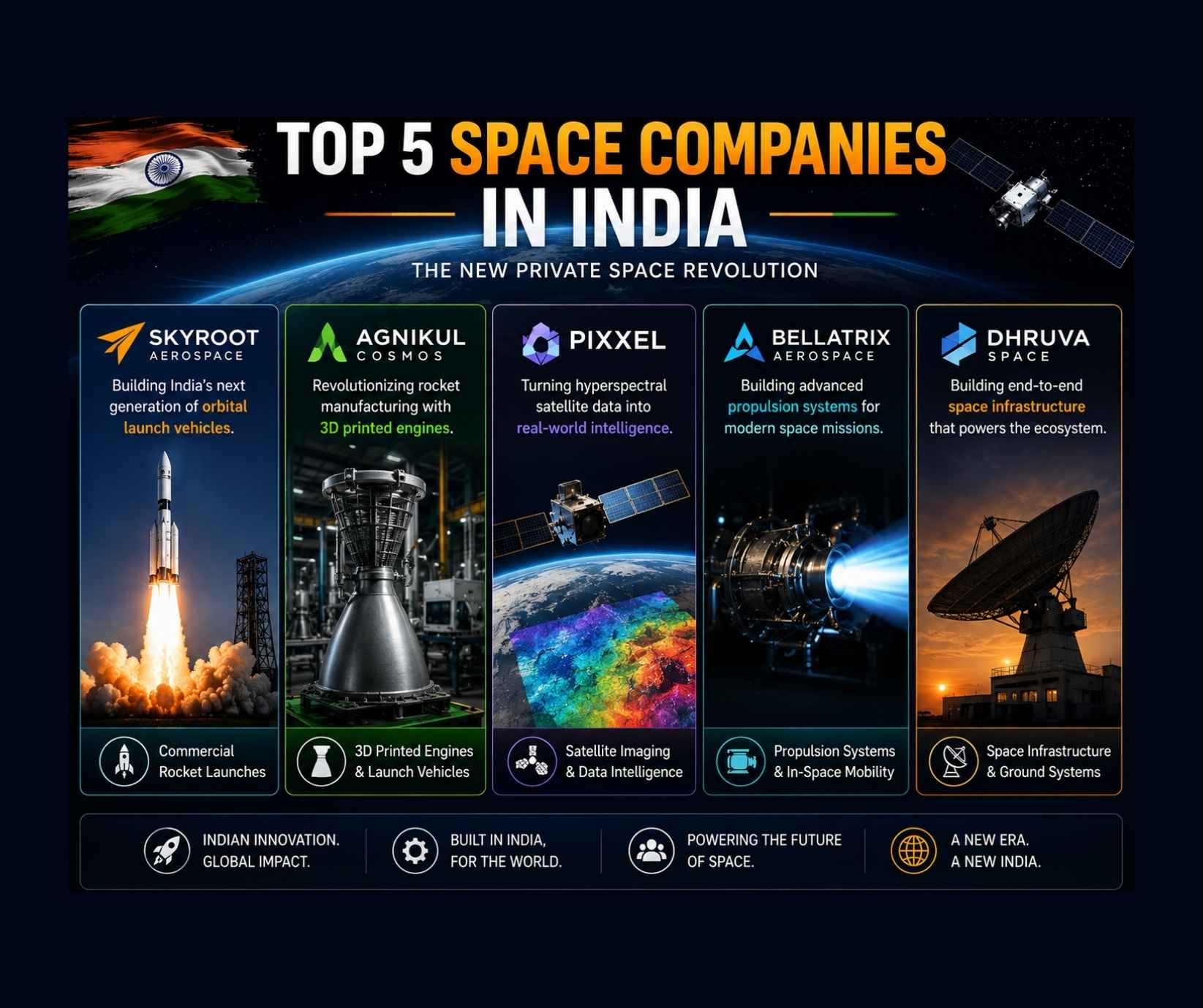
India’s space story has a new chapter. This time it is being written by private companies, not just government institutions.
The best aerospace startups India has produced over the last decade are now preparing for orbital launches, deploying hyperspectral satellite constellations, printing rocket engines with 3D technology, and building the propulsion and ground infrastructure that holds the entire ecosystem together. The private space sector India is building today is one of the most exciting deep-tech stories anywhere in the world, and 2026 is the year it steps fully into the global spotlight.
For most of the six decades since India sent its first satellite into orbit, the Indian Space Research Organisation was the sole architect of the country’s space ambitions. ISRO achieved extraordinary things, sending missions to the Moon and Mars, building a family of reliable launch vehicles, and training generations of world-class engineers. But government institutions, no matter how capable, operate within limits that private companies do not face. They move at the pace of policy cycles. They optimise for national prestige rather than commercial speed. They cannot pivot quickly when a market opportunity emerges.
India’s decision to open its space sector to private participation through IN-SPACe changed everything. Since that policy shift, the space companies in India that 2026 watchers are tracking have moved from early-stage experiments to serious commercial enterprises raising hundreds of millions of dollars and targeting global customers.
Five of them stand out above the rest. These are not companies to admire from a distance. They are companies that investors are actively backing, that satellite operators around the world are taking seriously, and that the next generation of Indian engineers is choosing to join over conventional career paths.
Here is a full breakdown of each one.
1. Skyroot Aerospace: India’s First Space Unicorn Prepares for Orbital History
Website: https://www.skyroot.in
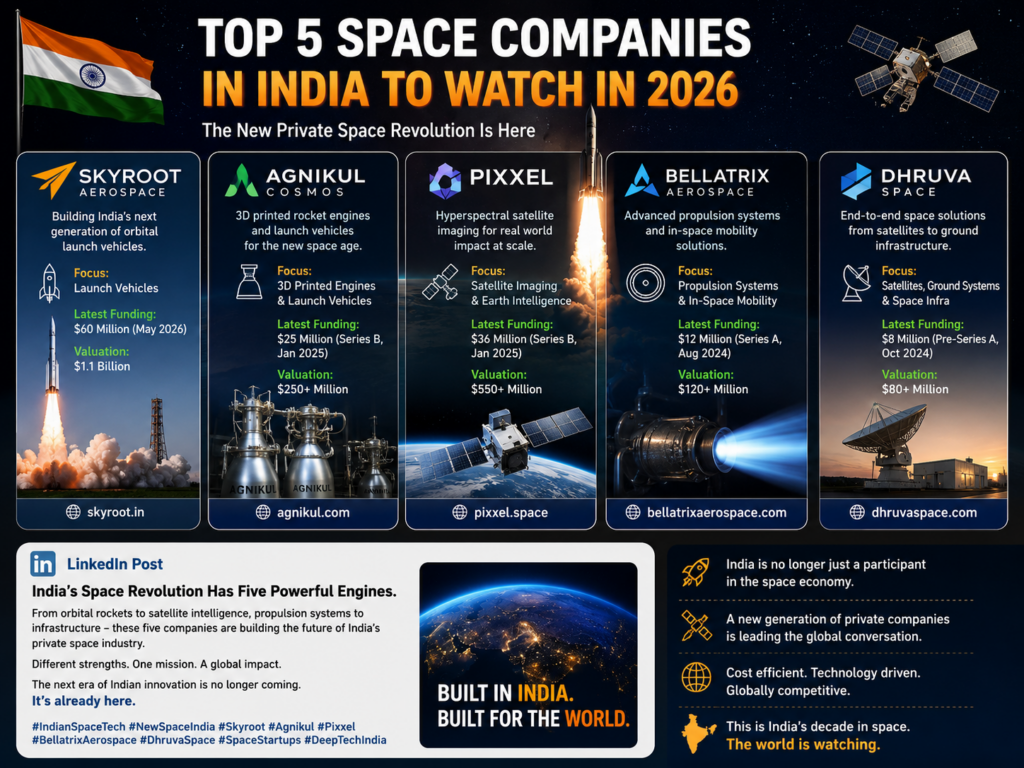
There is no better place to start than Skyroot Aerospace. Founded in 2018 by Pawan Kumar Chandana and Naga Bharath Daka, both former ISRO engineers, the Hyderabad-based company has already accomplished more than most private space startups achieve in their entire existence. Skyroot is India’s first and so far only space-tech unicorn, valued at approximately Rs 10,000 crore, and it is weeks away from what could be the most consequential commercial space launch in Indian history.
From ISRO to Entrepreneurship: The Origin Story
The founding story is one of the most compelling in India’s startup world. Chandana left a stable government job at ISRO earning Rs 75,000 a month to build a private rocket company from scratch, at a time when doing so in India had no regulatory framework, no precedent, and no guarantee of success. Eight years later, the company he and Daka built employs over 1,000 engineers with a median age of just 28 and has raised more than $160 million from investors including Singapore’s Temasek.
Skyroot’s first major milestone came in November 2022 when the Vikram-S, India’s first privately developed rocket, completed a successful suborbital flight from Sriharikota. That single event proved that an Indian startup team could design, manufacture, test, and launch a rocket without the institutional resources of a national space agency. It changed the conversation about what India’s private space sector could actually deliver.
H3: Vikram-1: The Launch That Could Change Everything
The Vikram-1, now scheduled for its maiden orbital launch in 2026, takes that ambition to the next level. It is a commercial orbital launch vehicle designed to carry approximately 300 kilograms of payload to low Earth orbit, with future upgrades targeting close to one tonne. It serves the booming global small satellite market, where more than 90 percent of satellites launched today weigh under 500 kilograms.
Chandana describes the commercial model simply. Skyroot is the Uber for space. Where large rideshare rockets function like buses carrying dozens of satellites to a shared orbit on a fixed schedule, Skyroot’s dedicated launch service lets customers choose their own orbit, their own launch window, and their own mission parameters. It is a premium service for operators who need flexibility and speed over the lowest possible cost per kilogram.
Why Made in India Gives Skyroot a Real Advantage
More than 90 percent of the components in Skyroot’s rockets are sourced within India from a network of over 400 domestic suppliers. This creates a genuine cost structure advantage over competitors operating in higher-wage environments and builds a domestic industrial ecosystem that strengthens with every launch. India’s geographic position near the equator at Sriharikota also provides natural efficiency advantages for a wide range of orbital profiles.
Looking further ahead, Skyroot’s roadmap includes the Vikram-2 with enhanced payload capacity, reusable rocket architecture to reduce long-term costs, and eventual human spaceflight ambitions. The immediate focus is on executing the Vikram-1 orbital launch and beginning the commercial launch cadence that proves the business model works at scale.
Founders: Pawan Kumar Chandana and Naga Bharath Daka Headquarters: Hyderabad Total Funding: Over $160 million Valuation: Approximately Rs 10,000 crore Technology: Small satellite orbital launch vehicles 2026 Milestone: Maiden orbital launch of Vikram-1
2. Agnikul Cosmos: Rewriting the Rules of Rocket Manufacturing
Website: https://www.agnikul.com
If Skyroot is India’s most prominent private launch company by valuation, Agnikul Cosmos is arguably its most technically audacious. The Chennai-based startup, founded in 2017 by Srinath Ravichandran and Moin SPM, has developed what it claims is the world’s first rocket with a fully 3D-printed, single-piece engine. That is not a marketing claim. It is a genuine engineering breakthrough that has drawn serious attention from aerospace professionals worldwide.
Why 3D-Printed Rocket Engines Are a Big Deal
To understand why it matters, consider what makes conventional rocket engine manufacturing so expensive. A traditional rocket engine is assembled from hundreds or thousands of individually machined components. Each one must be manufactured to extremely tight tolerances, inspected, cleaned, and assembled in sequence. The process can take months and requires specialised tooling and highly skilled labour at every stage. Every joint and weld is a potential failure point.
Agnikul’s approach eliminates most of that complexity. By printing the entire engine as a single continuous piece in one manufacturing operation, the company removes the majority of assembly steps, eliminates most joints and welds, compresses production time from months to days, and dramatically reduces per-unit cost. The design freedom of additive manufacturing also enables internal geometries that conventional machining simply cannot produce.
H3: The Agnibaan Rocket and What It Is Built to Do
The engine, called the Agnilet, powers the Agnibaan rocket, a two-stage vehicle capable of carrying up to 100 kilograms to low Earth orbit. It runs on a semi-cryogenic propellant combination using liquid oxygen and kerosene, balancing performance with operational simplicity. The payload capacity targets the rapidly growing CubeSat and nanosatellite segment where high launch frequency and low per-launch cost are the primary customer requirements.
In May 2024, Agnikul launched the Agnibaan SubOrbital Technological Demonstrator from its own private launch pad at Sriharikota. That made Agnikul the first Indian private company to successfully operate from a privately owned launch pad in India, adding another historic first to the country’s growing private space record.
Academic Roots and Investor Backing
The company was incubated at IIT Madras and maintains strong research and development ties there, giving it access to expertise and facilities that complement its commercial engineering work. It has raised funding from investors including Pi Ventures and Speciale Invest and continues to attract capital from investors who see the combination of novel manufacturing technology and growing market demand as a compelling long-term investment.
In 2026, Agnikul is working toward full orbital capability from its 3D-printed manufacturing base. If it succeeds, it will not just validate its own commercial model but potentially trigger a manufacturing revolution across the entire global launch industry.
Founders: Srinath Ravichandran and Moin SPM Headquarters: Chennai Technology: 3D-printed rocket engines, small orbital launch vehicles Key Achievement: World’s first single-piece 3D-printed rocket engine, first private launch pad in India 2026 Milestone: Progression toward commercial orbital launch
3. Pixxel: Giving the Planet a Hyperspectral Health
Check Website: https://www.pixxel.space
Not every important company in India’s private space sector builds rockets. The satellite side of the space economy is equally important and in terms of near-term commercial revenue, arguably more immediately accessible to new entrants. Pixxel, founded in 2019 by Awais Ahmed and Kshitij Khandelwal while both were still undergraduates at BITS Pilani, is building what it describes as the world’s highest-resolution hyperspectral Earth observation satellite constellation.
What Is Hyperspectral Imaging and Why Does It Matter
Hyperspectral imaging sounds highly technical until you understand the applications. Then it sounds essential.
Standard Earth observation satellites capture data in a handful of spectral bands, essentially the colours the human eye perceives plus some near-infrared. That is useful for many purposes but fundamentally limited in the depth of information it can reveal.
Hyperspectral sensors capture data across hundreds of distinct wavelength bands simultaneously, from ultraviolet through visible light and deep into the thermal infrared. The result is data that reveals the chemical composition of surface materials, the physiological health of crops at a molecular level, the presence of specific minerals in geological formations, the concentration of pollutants in water bodies, and dozens of other characteristics completely invisible to conventional satellite imagery.
Industries That Pixxel Is Already Transforming
The commercial applications span a wide range of industries. In agriculture, hyperspectral data can detect crop stress, disease, and nutrient deficiency weeks before visible symptoms appear, enabling precision interventions that reduce losses and improve yields. In mining, it can identify mineral deposits from orbit, dramatically cutting exploration costs and timelines. In environmental monitoring, it tracks deforestation, soil degradation, and water quality with a precision no other space-based technology can match.
Global Investors Are Paying Attention
Pixxel has already launched multiple satellites and is actively building its constellation toward global continuous coverage. The company has raised over $70 million from investors including Google, Lightspeed Venture Partners, and Radical Ventures, making it one of the most globally connected Indian space startups in operation today. Google’s participation is particularly significant, reflecting both the search giant’s strategic interest in geospatial data and its assessment of Pixxel’s technology as genuinely world-class.
The business model is built around data and analytics rather than hardware sales. Pixxel sells access to its hyperspectral imagery and to AI-driven analytical products derived from that imagery, generating recurring revenue and creating customer relationships that deepen over time as organisations integrate Pixxel’s data into their operational workflows.
Founders: Awais Ahmed and Kshitij Khandelwal Headquarters: Bengaluru with presence in San Francisco Total Funding: Over $70 million Key Investors: Google, Lightspeed Venture Partners, Radical Ventures Technology: Hyperspectral Earth observation satellites, geospatial AI analytics 2026 Milestone: Constellation expansion and commercial analytics platform growth
4. Bellatrix Aerospace: Powering Satellites from the Inside Out
Website: https://www.bellatrixaerospace.com
Among the best aerospace startups India has developed, Bellatrix Aerospace occupies a strategic niche that is easy to overlook but impossible to replace. While the companies above focus on rockets and observation satellites, Bellatrix solves the critical problem of what happens after a satellite reaches orbit.
How does it manoeuvre to its precise operational position?
How does it maintain that position against atmospheric drag?
How does it safely de-orbit at the end of its mission?
The answer to all of these questions is propulsion systems, and Bellatrix is one of the most technically sophisticated in-space propulsion companies operating anywhere in the world right now.
The Technology Behind Bellatrix
Founded in 2015 by Rohan Mitra and Yashas Karanam, both graduates of the Indian Institute of Science in Bengaluru, the company has spent nearly a decade developing a portfolio of thruster technologies covering the full range of small satellite propulsion requirements. Its product line includes microwave plasma thrusters, green monopropellant systems, and Hall effect thrusters, each optimised for different satellite sizes, mission profiles, and performance needs.
What separates Bellatrix from many propulsion companies is operational flight heritage. Its systems have flown on multiple real satellites, proving performance in actual space conditions rather than just in ground test chambers. This heritage is enormously valuable commercially because satellite operators are deeply risk-averse about propulsion failures, which can render an otherwise functional satellite completely useless.
A Regulatory Tailwind Driving Demand
The market opportunity is growing rapidly alongside the broader satellite industry. Regulatory requirements for active manoeuvring capability and end-of-life disposal are becoming mandatory rather than optional for new satellites. Both the European Space Agency and the US Federal Communications Commission are moving toward requiring propulsion systems on satellites above certain size thresholds. This regulatory tailwind creates sustained structural demand for exactly what Bellatrix produces.
H3: The Orbital Transfer Vehicle: Closing a Critical Gap
The company has also developed orbital transfer vehicle technology, essentially small space tugs capable of carrying multiple satellites from their deployment orbit to precise final destinations. This closes a real gap in the small launch vehicle ecosystem. When a rocket deploys a batch of satellites to a shared orbit, individual customers who need different final orbital slots can use Bellatrix’s transfer vehicles to reach their precise destinations. It is a service that increases the commercial value of every small rocket launch.
Bellatrix has attracted investment from New Space India Limited, ISRO’s commercial arm, as well as private venture capital, reflecting both the strategic importance the government places on indigenous propulsion capability and the genuine commercial attractiveness of the company’s position in a growing market.
Founders: Rohan Mitra and Yashas Karanam Headquarters: Bengaluru Technology: In-space propulsion systems, orbital transfer vehicles Key Investors: New Space India Limited, private venture capital 2026 Milestone: Production scaling and international customer base expansion
5. Dhruva Space: Building the Infrastructure That Ties the Ecosystem Together
Website: https://www.dhruvaspace.com
The fifth company on this list may not generate as many headlines as the others, but it may be among the most strategically important in the entire Indian space ecosystem. Dhruva Space, founded in 2012 by Sanjay Nekkanti, is one of the oldest private space companies in India and has accumulated more than a decade of operational experience in satellite development, launch services, and ground station infrastructure.
Why Operational Experience Sets Dhruva Apart
That experience matters more than it might seem. In a sector where most companies are still building toward their first milestone, Dhruva Space has already delivered. It had satellites aboard ISRO’s PSLV-C53 mission in 2022, qualifying its hardware on one of the most reliable launch vehicles in the world and demonstrating end-to-end delivery capability that younger companies are still working toward.
Three Business Lines That Make the Ecosystem Work
The company operates across three core business lines. It builds small satellites for customers who need space-based capabilities but lack the in-house engineering expertise to develop their own spacecraft. It brokers launch services, helping customers navigate the growing range of Indian and international launch options while managing the complex regulatory and logistical requirements of arranging a commercial launch. And it operates ground station infrastructure, the networks of antennas, receivers, and data processing systems that satellite operators need to communicate with their spacecraft and download the data they collect.
Why Ground Stations Are a Hidden Strategic Asset
The ground station business deserves particular attention because it is both strategically critical and widely underappreciated outside the industry. Every satellite in orbit needs to be regularly contacted by ground stations to upload commands, download data, update software, and monitor health status. As India’s satellite population grows, demand for ground station access will grow proportionally. Ground stations require substantial upfront investment but generate reliable recurring revenue once operational, creating an infrastructure business that becomes more valuable over time rather than facing the technology obsolescence risk that hardware companies must manage.
In an ecosystem where rocket companies and satellite technology firms dominate the headlines, Dhruva Space is doing the quieter but equally important work of building the connective tissue that holds India’s private space sector together. As that sector grows, the demand for the services Dhruva provides will grow right along with it.
Founder: Sanjay Nekkanti Headquarters: Hyderabad Technology: Small satellite development, launch services brokerage, ground station infrastructure 2026 Milestone: Satellite programme expansion and ground station network growth
Why the Private Space Sector India Is Building Matters Globally
The five companies profiled here are individually impressive. Collectively they represent something far more significant: the emergence of India as a genuine global player in commercial space technology, not as a supporting actor in someone else’s story but as a primary architect of the industry’s next chapter.
The best aerospace startups India has produced in the last decade have done so by combining the country’s extraordinary engineering talent with improving capital access, supportive government policy, and a global market expanding faster than existing supply can meet. The space companies in India 2026 observers are tracking benefit from structural advantages that compound over time. Lower engineering labour costs relative to the United States and Europe. A domestic manufacturing ecosystem growing in depth and precision capability. Geographic advantages for launch site positioning. And a government that has recognised private space as a strategic national priority.
The Market Forces Driving Every Company on This List
The single most important driver behind all five of these companies is the proliferation of small satellites. More than 90 percent of satellites launched today weigh under 500 kilograms. Earth observation constellations, direct-to-mobile communications networks, space-based data infrastructure, and growing sovereign space programmes across the developing world are all creating sustained demand for the kind of frequent, flexible, affordable launch access and satellite services that these companies are building.
This is not a temporary market spike. It is a structural transformation in how the world uses space-based infrastructure, analogous in scale and duration to the buildout of the terrestrial internet. The companies that establish strong positions in this market now will benefit from years of compounding advantage.
What 2026 Will Reveal About India’s Space Future
The twelve months ahead are likely to be the most revealing in the history of India’s private space industry. Skyroot’s Vikram-1 orbital launch will either validate or complicate the commercial timeline for India’s leading private launch provider. Agnikul’s progression toward orbital capability will test whether 3D-printed manufacturing can deliver at commercial scale. Pixxel’s constellation expansion will test the commercial appetite for hyperspectral analytics at global scale. Bellatrix and Dhruva will continue the critical work of building the propulsion and infrastructure capabilities that make the entire ecosystem function.
Together, by the end of 2026, the market will have a much clearer picture of which Indian space companies have the technology, the team, and the commercial model to become enduring global players.
The Indian space startups to watch in 2026 are not waiting for permission to compete globally. They are already competing, and they are winning contracts, raising capital, and building technology that demands to be taken seriously on the world stage.
H2: Final Thought: India’s Space Ambitions Are No Longer Just Government Property
India’s space ambitions were once embodied entirely in the achievements of ISRO. Today they are distributed across dozens of private companies, hundreds of startups at various stages of development, and thousands of engineers who chose to build new things rather than maintain existing ones.
Together they are building something that will matter long after the headlines from any individual launch have faded: a self-sustaining, globally competitive Indian private space industry capable of serving customers anywhere in the world from technology developed and manufactured entirely in India.
That is worth watching very closely in 2026 and for every year that follows.